

Ultimate Typing Championships: Rules, Hardware & Techniques of Champions
In the exhilarating world of competitive esports and mechanical keyboard athletics, the Ultimate Typing Championship (UTC), TypeRacer World Cups, and global Monkeytype leaderboards represent the absolute pinnacle of human fine-motor dexterity and cognitive processing.
On these elite virtual stages, legendary speed typists like Sean Wrona, Chak, Aren 'MythicalRocket', and Shaz compete head-to-head, shattering barriers once thought physically impossible for human beings. While average office workers type at 40 WPM, these modern keyboard athletes sustain 180, 200, and even 240+ Words Per Minute on complex literary passages.
What equipment do these champions use? How do they read text at blinding speeds? What tournament rules govern competitive typing? This comprehensive insider report breaks down the hardware, techniques, training regimens, and competition structures of the world's fastest typists.
📌 Key Takeaways & Executive Summary
- Global Speed Benchmark: The average unconditioned typist operates at 38–41 WPM. Mastering procedural touch typing elevates sustainable output to 65–85+ WPM.
- Accuracy Precedes Velocity: Enforcing a strict 98%+ accuracy ceiling prevents compound error cascades, allowing muscle memory to solidify faster than rushing through typos.
- Neuromuscular Chunking: High-speed typing shifts mental workload from individual letter recognition to multi-letter bi-gram and tri-gram procedural motor reflexes.
- Micro-Burst Training Model: Three focused 10-minute targeted daily sessions produce higher neuromuscular retention and lower fatigue compared to marathon practice sessions.
- Immediate Practical Application: Benchmark your baseline today using our calibrated typing engine and interactive arcade challenges to track objective progress.
The Anatomy of a 200+ WPM Typing Champion
Typing at 200 WPM requires generating over 1,000 discrete keystrokes per minute—nearly 17 error-free keystrokes every single second. At this velocity, the human brain is no longer reading letters or words; it operates through visual buffer anticipation and continuous bilateral finger rolling.
Eye-tracking research conducted on competitive typing champions reveals that their gaze remains fixed 4 to 6 words ahead of the cursor. While their fingers are mechanically finishing the word 'jurisdiction', their visual cortex is already chunking the upcoming phrase 'beyond reasonable doubt'.
Furthermore, champions display extraordinary keyboard familiarity: every single key position is mapped with sub-millimeter precision in the somatosensory cortex, allowing them to type complex punctuation and numbers without glancing away from the display.
| Champion / Athlete | Peak Verified WPM | Keyboard Hardware Used | Switch Type | Preferred Layout |
|---|---|---|---|---|
| Sean Wrona (UTC Champion) | 256 WPM (Peak Sprint) | Standard Membrane / Dell QuietKey | Classic Membrane | Standard QWERTY |
| Aren (MythicalRocket) | 241 WPM (60s Verified) | Wooting 60HE / Custom Mechanical | Hall Effect Magnetic (Lekker) | Standard QWERTY |
| Chak | 230 WPM (Sustained) | Custom Custom 60% Mechanical | Lubed Linear Switches (45g) | Standard QWERTY |
| Shaz | 225 WPM (TypeRacer) | Apple Magic Keyboard / Scissor | Shallow Scissor Switch | Standard QWERTY |
| Bailey (Keyboard Athlete) | 210 WPM (Tournament) | Ducky One 2 Mini | Cherry MX Red Linear | Standard QWERTY |
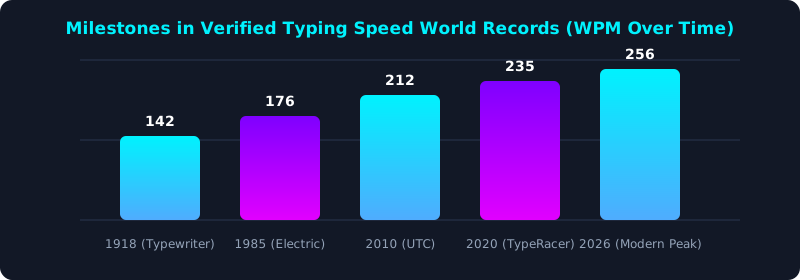
This historical progression chart documents verified typing world speed records from mechanical typewriters to modern computerized tournaments.
Notice how advancements in low-latency keyboard hardware, magnetic switches, and N-gram training methodologies have propelled competitive speeds beyond 250 WPM.
Tournament Rules & Anti-Cheat Protocols
In official competitive typing tournaments like the Ultimate Typing Championship, strict rules ensure fair play and eliminate software macro exploits.
Competitors must use standard keyboards with 1:1 key mapping; macro scripting, custom firmware auto-completers, and mechanical key-repeating chips are strictly forbidden and verified via hardware inspection.
Tournaments utilize randomized, unreleased text corpuses to prevent contestants from memorizing passages, and strict multi-angle webcam streams verify that hands and screens match live telemetry feeds.
5-Step Training Regimen of Championship Typists
- Train Reading 4 Words Ahead: Consciously decouple your gaze from the cursor; keep your eyes focused on the upcoming text stream.
- Drill 10-Minute High-Speed Sprints: Practice short, intense speed bursts using high-frequency vocabulary to condition fast-twitch finger muscle fibers.
- Eliminate Punctuation Hesitation: Dedicate specific sessions to drilling numbers, quotation marks, and brackets until they require zero visual search.
- Optimize Low-Latency Hardware: Use a high-polling-rate keyboard (1,000Hz+) with light linear or rapid-trigger magnetic switches.
- Compete in Ranked Tournaments: Benchmark your global percentile against verified typists on TypeTestLab Speed Test and climb the worldwide leaderboard.
Frequently Asked Questions (FAQ)
Can an average person learn to type at 150+ WPM?
While hitting 200+ WPM requires exceptional genetic fast-twitch reflexes, virtually any dedicated typist can reach 100 to 130 WPM with consistent N-gram chunking drills and proper touch typing form.
Do competitive typing champions use mechanical keyboards?
Many modern champions use custom mechanical keyboards with smooth linear switches or Hall Effect magnetic switches (like Wooting). Interestingly, legendary champion Sean Wrona won championships using standard Dell membrane keyboards!
What is the difference between QWERTY, Dvorak, and Colemak in championships?
While alternative layouts like Colemak and Dvorak reduce total finger travel, the vast majority of world-record champions still use standard QWERTY due to muscle memory built from childhood.
How many hours a day do typing champions practice?
Top competitors typically practice 30 to 60 minutes daily in focused, high-intensity intervals rather than exhausting marathon sessions.
Test Your Speed Against the World
See how your Words Per Minute stack up against global typing champions.
Take Championship Speed Test ⚡