
Achieving Typing Flow State: Conquering Performance Anxiety on Timed Tests
You sit down at your computer in a calm, relaxed environment, open a casual speed test, and easily cruise past 85 Words Per Minute with flawless 98% accuracy. But the moment you log into an official pre-employment screening exam, a proctored certification test, or a high-stakes job interview, something disastrous happens.
Your heart begins pounding in your chest, your palms grow cold and clammy, your breath turns shallow, your fingers stiffen into rigid claws, and within the first twenty seconds, you make three agonizing typos. You panic, hammer the backspace key, and finish with a demoralizing 48 Net WPM.
This psychological phenomenon is known as 'performance choking' or testing anxiety. In cognitive sports psychology, peak performance requires entering the 'Flow State'—a state of relaxed, effortless absorption where the analytical mind steps aside and motor memory executes autonomously. This mental conditioning guide teaches you how to master the psychology of timed assessments.
📌 Key Takeaways & Executive Summary
- Global Speed Benchmark: The average unconditioned typist operates at 38–41 WPM. Mastering procedural touch typing elevates sustainable output to 65–85+ WPM.
- Accuracy Precedes Velocity: Enforcing a strict 98%+ accuracy ceiling prevents compound error cascades, allowing muscle memory to solidify faster than rushing through typos.
- Neuromuscular Chunking: High-speed typing shifts mental workload from individual letter recognition to multi-letter bi-gram and tri-gram procedural motor reflexes.
- Micro-Burst Training Model: Three focused 10-minute targeted daily sessions produce higher neuromuscular retention and lower fatigue compared to marathon practice sessions.
- Immediate Practical Application: Benchmark your baseline today using our calibrated typing engine and interactive arcade challenges to track objective progress.
The Neurobiology of Choking Under Testing Pressure
When high stakes are introduced, your brain's amygdala interprets the test timer as an existential threat, triggering an involuntary sympathetic nervous system response: the 'fight-or-flight' surge. Epinephrine and cortisol flood your bloodstream.
This hormonal surge dilates pupils and tenses large leg muscles for running—but it is catastrophic for fine-motor control. Blood vessels in your fingertips constrict, fine finger tremors appear, and working memory in the prefrontal cortex becomes overloaded with anxious self-talk ('If I fail this, I won't get the job!').
This internal panic disrupts the cerebellum's automated motor programs, forcing you back into conscious, clumsy letter-by-letter typing. Conquering testing anxiety requires down-regulating this nervous system response through deliberate physiological techniques.
| Mental State | Dominant Brainwave | Heart Rate Response | Keystroke Cadence | Typical WPM Performance |
|---|---|---|---|---|
| Acute Test Anxiety (Panic) | High Beta Waves (>25 Hz) | Elevated (110 - 130 BPM) | Erratic, Staccato, Jittery | 40 - 55 Net WPM (Choking) |
| Over-Conscious Effort (Trying Hard) | Mid Beta Waves (18 - 24 Hz) | Elevated (90 - 105 BPM) | Forced, Tense, Micro-Hesitations | 60 - 70 WPM (Plateaued) |
| Optimal Flow State (The Zone) | Alpha-Theta Border (8 - 12 Hz) | Calm & Stable (65 - 75 BPM) | Isochronous, Effortless, Fluid | 85 - 110+ Net WPM (Peak Output) |
| Casual Practice Mode | Alpha Waves (10 - 14 Hz) | Relaxed (70 - 80 BPM) | Natural, Smooth Rhythm | 75 - 90 WPM |
| Fatigued / Distracted Mode | Erratic Brainwave Drift | Variable | Sluggish, Delayed Reactions | 55 - 65 WPM |
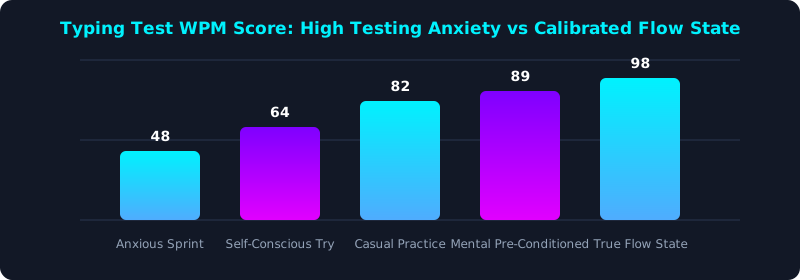
This psychological study illustrates how mental state governs typing test outcomes. Testing anxiety causes a staggering 50 WPM drop compared to performance in the Flow State.
Mastering physiological calming techniques allows candidates to unlock their true potential when high-stakes employment tests begin.
The Physiological Sigh & Pre-Test Reset Routine
To instantly shut down an adrenaline surge before a timed typing exam begins, neuroscientists recommend the 'Physiological Sigh': take two rapid, deep breaths in through your nose, followed by a long, slow exhale through your mouth. Doing this twice immediately triggers the parasympathetic vagus nerve, slowing your heart rate in seconds.
Next, practice 'Soft Eyes': widen your visual field to take in the edges of the room rather than staring intensely at the countdown timer. Peripheral vision activation reduces amygdala activity and promotes calm alpha brainwaves.
Finally, banish all thoughts of speed or outcome. Shift your entire mental focus to a single tactile sensation: the smooth, rhythmic tapping of your fingertips on the home row keys.
5-Step Flow State Conditioning Blueprint for High-Stakes Tests
- Execute the Double-Inhale Sigh: Take two deep nasal inhales followed by a prolonged oral exhale right before your exam begins to reset your heart rate.
- Practice 'Soft Eyes' Peripheral Gaze: Widen your visual focus so you are not hyper-fixated on the countdown timer or error indicators.
- Set a 85% Initial Cadence Target: Consciously begin the first 30 seconds of the test at 85% speed; establishing rhythm first prevents early panic typos.
- Reframe Errors as Normal Flow: When a typo occurs, acknowledge it with complete emotional neutrality and continue forward with unbroken rhythm.
- Desensitize Through Regular Certification: Take official timed assessments on TypeTestLab Speed Test and earn Official Typing Certificate awards until test pressure feels completely routine.
Frequently Asked Questions (FAQ)
Why do I type so much slower when someone is watching me?
This is called the 'social facilitation effect'. When observed by an employer or proctor, your self-monitoring circuits become overactive, interfering with the subconscious motor automation needed for fast typing.
How can I calm my shaking hands before an employment typing test?
Run warm water over your hands for 2 minutes to dilate blood vessels, perform two physiological sighs, and shake out your wrists lightly to release excess adrenaline.
Should I listen to music while typing to get into flow?
For practice, ambient instrumental music (like lo-fi or binaural beats) helps induce flow. However, because proctored exams do not allow headphones, practice typing in quiet environments as test day approaches.
What is the single best mental tip for timed tests?
Focus 100% on smooth, continuous rhythm rather than raw speed. Speed is a natural byproduct of flawless, relaxed rhythm.
Master Unshakeable Testing Composure
Conquer test anxiety and unlock your true speed in our proctored assessment engine.
Take Flow State Speed Test ⚡