
WPM vs CPM: Understanding Words Per Minute & Characters Per Minute
When measuring keyboard speed, two dominant metrics are used worldwide: Words Per Minute (WPM) and Characters Per Minute (CPM). While North American hiring agencies and educational institutions overwhelmingly favor WPM, many European, Asian, and international testing platforms measure efficiency in CPM or Keystrokes Per Hour (KPH).
Understanding how these metrics relate, how standardized word lengths are defined, and how to convert between WPM and CPM is essential for job applicants participating in international hiring assessments.
This article explains the mathematical formulas behind WPM and CPM, explores why 5 characters equal 1 standardized word, and provides concrete tools to convert your scores accurately.
📌 Key Takeaways & Executive Summary
- Global Speed Benchmark: The average unconditioned typist operates at 38–41 WPM. Mastering procedural touch typing elevates sustainable output to 65–85+ WPM.
- Accuracy Precedes Velocity: Enforcing a strict 98%+ accuracy ceiling prevents compound error cascades, allowing muscle memory to solidify faster than rushing through typos.
- Neuromuscular Chunking: High-speed typing shifts mental workload from individual letter recognition to multi-letter bi-gram and tri-gram procedural motor reflexes.
- Micro-Burst Training Model: Three focused 10-minute targeted daily sessions produce higher neuromuscular retention and lower fatigue compared to marathon practice sessions.
- Immediate Practical Application: Benchmark your baseline today using our calibrated typing engine and interactive arcade challenges to track objective progress.
The Standardized Mathematical Formula: Why 5 Characters = 1 Word
If a test measured raw word counts without standardization, a typist keying short words ('cat', 'the', 'and') would achieve a artificially inflated WPM compared to a typist entering complex medical vocabulary ('electroencephalogram', 'gastroenterology').
To eliminate word-length bias, international testing organizations defined a 'standard word' as exactly 5 characters, including spaces and punctuation. Therefore, 1 WPM is mathematically defined as 5 CPM.
Formula for WPM: WPM = (Total Keystrokes / 5) / Total Minutes. Formula for CPM: CPM = WPM * 5. For example, if you type at 300 CPM, your standardized speed is exactly 60 WPM.
| Metric Name | Abbreviation | Standard Definition | Conversion to WPM | Primary Geographic Region |
|---|---|---|---|---|
| Words Per Minute | WPM | 5 Characters / Spaces | Baseline (1:1) | USA, UK, Canada, Australia |
| Characters Per Minute | CPM | Individual Key Press | CPM ÷ 5 = WPM | Germany, France, EU, Asia |
| Keystrokes Per Hour | KPH | Total Keys in 60 Mins | KPH ÷ 300 = WPM | Global Data Entry / Finance |
| Gross WPM | GWPM | Raw Words without Penalty | Uncorrected Speed | Preliminary Screenings |
| Net WPM | NWPM | GWPM minus Errors | Final Verified Speed | Official Pre-Employment Exams |
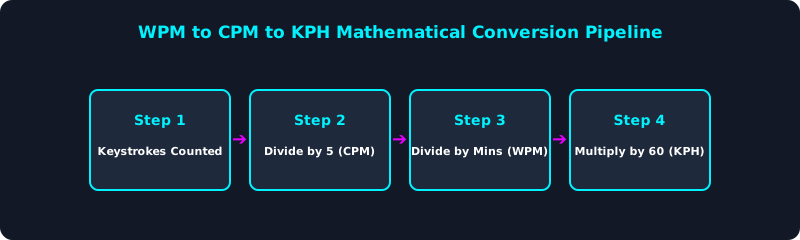
The conversion flowchart above illustrates how raw physical keystrokes flow through mathematical algorithms to yield standardized WPM, CPM, and KPH scores.
Using standardized conversions ensures fair performance comparisons regardless of language, document length, or testing region.
KPH in Data Entry & Financial Operations
In high-volume data entry, logistics, and banking sectors, speed is often evaluated using 10-Key numerical keypads measured in Keystrokes Per Hour (KPH).
A benchmark speed of 10,000 KPH corresponds to roughly 33.3 WPM or 166.6 CPM. Employers in billing and inventory management typically require a minimum of 8,000 to 12,000 KPH with 99% accuracy.
You can evaluate your numeric and alphanumeric KPH efficiency using our specialized job tools.
5-Step Guide to Master WPM & CPM Conversions
- Calculate Baseline CPM: Take a test on TypeTestLab Speed Test and multiply your Net WPM score by 5 to determine your CPM.
- Audit Character-Level Accuracy: Identify whether errors stem from complex symbol keys or standard letter sequences.
- Practice High-CPM Symbol Drills: Utilize TypeTestLab Structured Lessons to build fluency with numbers, brackets, and uppercase punctuation.
- Calculate 10-Key KPH Metrics: Use the interactive Career WPM Matrix to calculate your numeric KPH for data entry roles.
- Export Dual Metric Certificates: Earn an official Official Typing Certificate displaying both WPM and CPM scores for international recruiters.
Frequently Asked Questions (FAQ)
How do I convert CPM to WPM?
Simply divide your CPM score by 5. For example, 250 CPM divided by 5 equals 50 WPM.
Why do European tests use CPM instead of WPM?
CPM provides higher granular precision for non-English languages with varying average word lengths.
What is a good CPM speed for jobs?
A speed of 250 to 300 CPM (50–60 WPM) is considered good for general corporate roles.
Does spaces count as characters in CPM?
Yes, spaces and punctuation marks count as valid characters in standardized CPM calculations.
Where can I test both WPM and CPM?
The testing engine on TypeTestLab Speed Test displays real-time WPM, CPM, and accuracy metrics simultaneously.
Calculate Your WPM & CPM Scores Now
Test your speed on TypeTestLab to view your instantaneous WPM and CPM results.
Start Dual Metric Test ⚡