
Carpal Tunnel Syndrome Prevention & Exercises for 8-Hour Typists
Notice: This guide is published strictly for educational, postural, and ergonomic awareness. It does not provide clinical diagnosis or medical treatment. If you experience persistent wrist numbness, severe joint pain, shooting nerve sensations, or muscle weakness, discontinue intensive typing immediately and consult a licensed physician or physical therapist.
Carpal Tunnel Syndrome (CTS) is one of the most common occupational nerve disorders affecting heavy typists, office workers, and software engineers.
CTS occurs when the median nerve running through the narrow carpal tunnel in your wrist becomes compressed due to inflamed flexor tendons, causing numbness, tingling, and grip weakness.
This guide outlines early warning symptoms, ergonomic prevention techniques, and 5 wrist exercises designed for 8-hour typists.
📌 Key Takeaways & Executive Summary
- Global Speed Benchmark: The average unconditioned typist operates at 38–41 WPM. Mastering procedural touch typing elevates sustainable output to 65–85+ WPM.
- Accuracy Precedes Velocity: Enforcing a strict 98%+ accuracy ceiling prevents compound error cascades, allowing muscle memory to solidify faster than rushing through typos.
- Neuromuscular Chunking: High-speed typing shifts mental workload from individual letter recognition to multi-letter bi-gram and tri-gram procedural motor reflexes.
- Micro-Burst Training Model: Three focused 10-minute targeted daily sessions produce higher neuromuscular retention and lower fatigue compared to marathon practice sessions.
- Immediate Practical Application: Benchmark your baseline today using our calibrated typing engine and interactive arcade challenges to track objective progress.
Early Symptoms vs. Advanced Carpal Tunnel Stages
Recognizing early warning signs—such as nocturnal thumb numbness or tingling in the index and middle fingers—allows typists to intervene before nerve damage becomes severe.
| CTS Stage | Primary Physical Symptoms | Impact on Typing Speed | Recommended Intervention |
|---|---|---|---|
| Stage 1: Early Warning | Intermittent thumb & index tingling, night pain | Minor WPM drop (-5 WPM) | Ergonomic Adjustment & Stretches |
| Stage 2: Moderate Compression | Persistent numbness, wrist stiffness, grip weakness | Noticeable WPM drop (-15 WPM) | Night Wrist Splints & Physical Therapy |
| Stage 3: Advanced Impairment | Constant numbness, muscle atrophy at thumb base | Severe typing impairment | Medical Evaluation & Surgical Consultation |
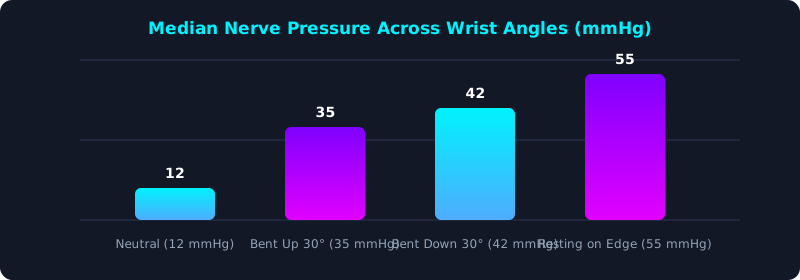
This clinical data graph proves that bending or resting wrists on desk edges increases median nerve pressure by over 300%.
5 Essential Wrist & Tendon Gliding Exercises
Tendon gliding exercises (finger extension, wrist flexor stretch, median nerve glide) help lubricate flexor tendons and relieve carpal tunnel pressure.
5 Daily Exercises for Carpal Tunnel Relief
- Prayer Stretch: Press palms together at chest level and lower hands until a gentle forearm stretch is felt.
- Wrist Flexor Stretch: Extend arm forward, palm up, and gently pull fingers downward with opposite hand.
- Tendon Glides: Move fingers sequentially from claw fist to full flat hand to slide tendons.
- Wrist Extension Stretch: Extend arm forward, palm down, and gently press hand downward.
- Shake-It-Out Break: Perform 10-second wrist shakes every 30 minutes to restore circulation.
Frequently Asked Questions (FAQ)
What is the first sign of Carpal Tunnel Syndrome?
Tingling or numbness in the thumb, index, and middle fingers, especially at night or after long typing sessions.
Can Carpal Tunnel Syndrome be reversed without surgery?
Yes! Early-stage CTS can be reversed through ergonomic adjustments, wrist splints, and physical therapy.
Which fingers are affected by Carpal Tunnel?
CTS affects the thumb, index, middle finger, and thumb-side half of the ring finger.
Should I wear a wrist splint while typing?
No, splints should be worn at night to prevent wrist bending during sleep, not while actively typing.
Where can I find healthy typing exercises?
Access ergonomic practice modules on TypeTestLab Structured Lessons.
Prevent Carpal Tunnel Strain Today
Learn healthy typing habits and test your WPM on TypeTestLab.
Start Healthy Typing Lessons ⚡