
Word Chunking & N-Gram Drills: Reprogramming Your Brain for 100+ WPM
Every typist who has ever hit a stubborn speed plateau around 60 to 70 Words Per Minute eventually asks the same fundamental question: What separates intermediate typists from the elite echelon of 100+ WPM masters?
Cognitive psychology and neuroscience provide a clear answer: intermediate typists process words letter-by-letter, while elite typists process language in multi-character 'chunks' known as N-grams. When an elite typist reads the word 'the', their brain does not issue three separate commands for T, H, and E; it triggers a single, integrated motor reflex.
By training your cerebellar procedural memory on high-frequency bi-grams, tri-grams, and quadri-grams, you compress cognitive latency and unlock the neurological foundation required for true triple-digit typing velocity.
📌 Key Takeaways & Executive Summary
- Global Speed Benchmark: The average unconditioned typist operates at 38–41 WPM. Mastering procedural touch typing elevates sustainable output to 65–85+ WPM.
- Accuracy Precedes Velocity: Enforcing a strict 98%+ accuracy ceiling prevents compound error cascades, allowing muscle memory to solidify faster than rushing through typos.
- Neuromuscular Chunking: High-speed typing shifts mental workload from individual letter recognition to multi-letter bi-gram and tri-gram procedural motor reflexes.
- Micro-Burst Training Model: Three focused 10-minute targeted daily sessions produce higher neuromuscular retention and lower fatigue compared to marathon practice sessions.
- Immediate Practical Application: Benchmark your baseline today using our calibrated typing engine and interactive arcade challenges to track objective progress.
The Cognitive Science of Chunking & Motor Programs
In motor learning science, 'chunking' is the process by which individual units of information or motor actions are bound together into an integrated, automatic sequence. When a beginner types, each keystroke requires visual recognition, spatial translation, and voluntary motor activation.
As mastery develops, the brain's basal ganglia compiles high-frequency letter combinations into pre-packaged neural subroutines. In English, just 30 common bi-grams (such as 'th', 'he', 'in', 'er', 'an', 're') and 20 tri-grams ('the', 'and', 'ing', 'ion', 'tio') account for over 45% of all written text.
When you train your fingers to execute these common letter clusters as single fluid motions—similar to a pianist playing a smooth musical chord—your keystroke speed multiplies effortlessly without increasing conscious mental effort.
| N-Gram Type | Top Examples | Percentage of English Text | Intermediate Execution | Master Chunk Execution |
|---|---|---|---|---|
| Top Bi-Grams (2 Letters) | th, er, on, an, in, he, nd, ed | 32.5% | 2 Separate Conscious Taps | Single Fluid Rolling Motion |
| Top Tri-Grams (3 Letters) | the, and, ing, ion, tio, ent, ati | 18.2% | 3 Staccato Keystrokes | Automated Motor Reflex |
| Top Quadri-Grams (4 Letters) | tion, ther, that, with, have, from | 11.4% | Deliberate Spelling Sequence | Single Blended Hand Roll |
| Common Word Roots | inter-, trans-, auto-, multi-, sub- | 8.6% | Fragmented Key Search | Instantaneous Motor Unit |
| Common Suffixes | -ment, -able, -ness, -ence, -fully | 7.1% | Slow Letter-by-Letter Closure | Subconscious Finger Flush |
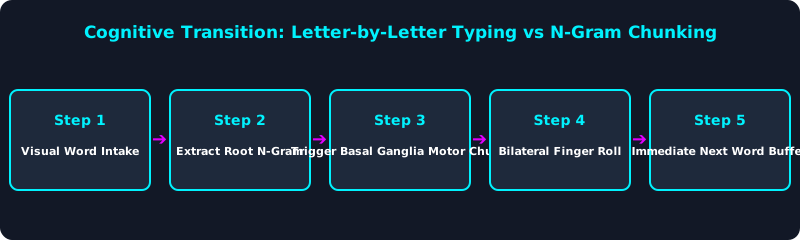
This cognitive workflow illustrates how elite typists process words. Instead of looping through letter-by-letter visual validation, the brain buffers the entire word and triggers pre-compiled N-gram motor chunks.
This frees up working memory to read 2 to 3 words ahead in the text stream, completely eliminating pauses between words.
High-Velocity Finger Rolling Drills
To build motor chunks, you must practice 'finger rolling'—striking adjacent keys in rapid succession using a single continuous hand tilt rather than stiff, isolated finger jabs.
In inward rolls (such as typing 'in' or 'er'), your hand tilts slightly inward as the outer finger strikes followed immediately by the inner finger. This physiological motion is significantly faster than vertical up-and-down tapping.
Practicing dedicated N-gram isolation drills for 10 minutes a day trains your cerebellum to fire finger movements in coordinated unison.
5-Step N-Gram Chunking Mastery Blueprint
- Isolate High-Frequency Bi-Grams: Spend 5 minutes drilling the top 10 English bi-grams (th, he, in, er, an, re, ed, on, es, st) until they feel like single keystrokes.
- Practice Continuous Hand Rolls: Focus on relaxed, inward finger rolling motions rather than stiff, robotic finger extensions.
- Look 2 to 3 Words Ahead: Train your eyes to scan forward in the sentence while your hands finish keying the current motor chunk.
- Target Difficult Suffixes: Practice common suffixes (-tion, -ment, -able, -ing) until your fingers complete word endings automatically.
- Benchmark Your Triple-Digit Speed: Test your rolling velocity on TypeTestLab Speed Test and watch your WPM surge past previous plateaus.
Frequently Asked Questions (FAQ)
Why am I stuck at 60 WPM despite practicing every day?
A 60 WPM plateau almost always indicates you are still processing text letter-by-letter. To break through, you must intentionally train N-gram motor chunking and practice reading several words ahead.
What is an inward finger roll in touch typing?
An inward finger roll occurs when you strike keys sequentially moving from outer fingers toward the center (e.g., ring finger then index finger). This natural biomechanical motion is the fastest movement on a keyboard.
Can N-gram chunking increase typing errors?
Initially, attempting to type faster chunks may cause occasional transposition errors (e.g., typing 'teh' instead of 'the'). However, deliberate practice quickly resolves this, locking in high-speed accuracy.
How long does it take to reprogram muscle memory for N-grams?
Consistent 15-minute daily N-gram drills on TypeTestLab typically rewire motor memory within 3 to 4 weeks, routinely yielding a 20 to 30 WPM speed increase.
Break Through to 100+ WPM
Master N-gram chunking and unlock elite keystroke velocity.
Take Advanced Speed Assessment ⚡