
Why Typing Accuracy Trumps Raw WPM Speed (The Cost of Errors)
In the pursuit of faster typing, many users focus exclusively on pushing their raw Words Per Minute (WPM) score higher. However, speed without accuracy is an illusion. In real-world office environments and pre-employment exams, typing fast while making frequent typos is far less productive than typing at a steady, error-free pace.
This article explores the mathematical and operational costs of typing errors, demonstrates how backspacing destroys productivity, and provides actionable drills to lock in 98%+ accuracy.
📌 Key Takeaways & Executive Summary
- Global Speed Benchmark: The average unconditioned typist operates at 38–41 WPM. Mastering procedural touch typing elevates sustainable output to 65–85+ WPM.
- Accuracy Precedes Velocity: Enforcing a strict 98%+ accuracy ceiling prevents compound error cascades, allowing muscle memory to solidify faster than rushing through typos.
- Neuromuscular Chunking: High-speed typing shifts mental workload from individual letter recognition to multi-letter bi-gram and tri-gram procedural motor reflexes.
- Micro-Burst Training Model: Three focused 10-minute targeted daily sessions produce higher neuromuscular retention and lower fatigue compared to marathon practice sessions.
- Immediate Practical Application: Benchmark your baseline today using our calibrated typing engine and interactive arcade challenges to track objective progress.
The True Math of Typing Errors & Time Loss
When you make a typo, you don't just lose the time spent hitting the wrong key. You must stop typing, detect the error, press Backspace multiple times, re-key the correct character, and resume your typing flow.
A single error costs an average of 4 to 6 keystrokes in wasted motion. If a typist makes 10 errors per minute while typing at 70 Gross WPM, their net effective output drops below 50 WPM due to correction overhead.
| Accuracy Rate | Gross WPM | Uncorrected Errors / Min | Time Spent Backspacing | Effective Net WPM |
|---|---|---|---|---|
| 100% (Flawless) | 60 WPM | 0 Errors | 0 Seconds | 60.0 NWPM |
| 98% (High Precision) | 65 WPM | 1 Error | 2.5 Seconds | 63.8 NWPM |
| 95% (Standard) | 70 WPM | 3 Errors | 7.5 Seconds | 64.0 NWPM |
| 90% (Error-Prone) | 75 WPM | 7 Errors | 17.5 Seconds | 57.5 NWPM |
| 85% (Sloppy Burst) | 80 WPM | 12 Errors | 30.0 Seconds | 50.0 NWPM |
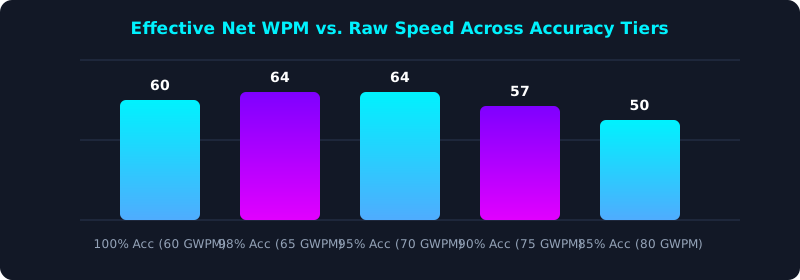
This graph proves that a typist at 80 Gross WPM with 85% accuracy produces LESS net work than a steady 60 WPM typist with 100% accuracy!
Neuromuscular Habits: How Accuracy Drives Speed
Muscle memory is established through exact repetition. Every time you key a mistake, your brain registers conflicting spatial coordinates, hindering the consolidation of motor pathways. Practicing slowly and accurately builds clean neural pathways that naturally increase speed over time.
5-Step Blueprint for 99% Typing Accuracy
- Enforce the 98% Rule: If your accuracy drops below 98% during practice, immediately slow down your tempo by 15%.
- Focus on Rhythmic Keystrokes: Type with a steady metronome rhythm rather than frantic speed bursts.
- Anchor Your Homing Fingers: Keep your index fingers anchored on F and J using TypeTestLab Structured Lessons.
- Disable Backspacing in Drills: Practice on strict zero-backspace mode to train first-time accuracy.
- Measure Net Progress Weekly: Track your Net WPM vs Gross WPM ratio on TypeTestLab Speed Test.
Frequently Asked Questions (FAQ)
Why does Net WPM drop so fast when I make errors?
Net WPM algorithms penalize uncorrected errors heavily to reflect the real-world cost of editing mistakes.
What is considered a good accuracy rate?
95% accuracy is acceptable for general work, but 98%+ is required for competitive data entry and transcribing roles.
How can I break the habit of hitting Backspace?
Practice on custom drills that disable the Backspace key entirely, forcing your brain to slow down and hit keys accurately.
Does slow, accurate typing build long-term speed?
Yes! Perfect repetition builds clean neuromuscular memory, which leads to effortless speed over time.
Where can I test my exact accuracy percentage?
Take a timed test on TypeTestLab Speed Test to get an immediate readout of your accuracy percentage.
Build Flawless Typing Accuracy Today
Test your accuracy rate and learn how precision unlocks higher Net WPM.
Start Accuracy Assessment ⚡