
Micro-Breaks & The Pomodoro Method: Sustaining 80+ WPM Across 8-Hour Workdays
In modern knowledge work, corporate productivity is frequently measured by sustained throughput across 8-to-10-hour workdays. Legal secretaries, software engineers, medical scribes, and customer support agents often spend entire shifts in continuous keyboard engagement.
However, human fine-motor performance is governed by immutable biological constraints. When typists attempt marathon 3-hour unbroken typing sessions, forearm muscles accumulate metabolic waste, postural alignment collapses into a slouched hunch, error rates double, and typing velocity plummets by 30% by mid-afternoon.
Integrating structured micro-breaks and the famous Pomodoro Technique (25 minutes of deep typing followed by a 5-minute recovery interval) allows high-performance typists to sustain 80+ WPM velocity from morning until evening without physical or mental burnout.
📌 Key Takeaways & Executive Summary
- Global Speed Benchmark: The average unconditioned typist operates at 38–41 WPM. Mastering procedural touch typing elevates sustainable output to 65–85+ WPM.
- Accuracy Precedes Velocity: Enforcing a strict 98%+ accuracy ceiling prevents compound error cascades, allowing muscle memory to solidify faster than rushing through typos.
- Neuromuscular Chunking: High-speed typing shifts mental workload from individual letter recognition to multi-letter bi-gram and tri-gram procedural motor reflexes.
- Micro-Burst Training Model: Three focused 10-minute targeted daily sessions produce higher neuromuscular retention and lower fatigue compared to marathon practice sessions.
- Immediate Practical Application: Benchmark your baseline today using our calibrated typing engine and interactive arcade challenges to track objective progress.
The Physiology of Motor Fatigue & Lactic Acid Clearance
Every rapid keystroke requires micro-contractions in the flexor and extensor muscles of the forearm. During continuous typing, intramuscular pressure partially restricts capillary blood flow, leading to localized cellular hypoxia and metabolic waste accumulation.
Studies in occupational ergonomics show that after 25 minutes of continuous typing, fine-motor accuracy drops by 4.2% as muscle spindles experience low-level fatigue. If the typist pushes through without resting, fatigue compounds exponentially.
Conversely, taking a brief 30-to-60-second micro-break every 20 to 25 minutes restores full arterial blood circulation, flushes metabolic byproducts, and recalibrates cerebellar motor timing, restoring fresh-hand performance immediately.
| Work Schedule Protocol | Continuous Typing Duration | Rest Interval | End-of-Day WPM Retention | Reported Physical Fatigue |
|---|---|---|---|---|
| Unbroken Marathon Typing | 3 - 4 Hours Uninterrupted | 0 Minutes (No Breaks) | 58% of Morning Peak (Severe Drop) | Severe Forearm & Neck Pain |
| Standard Irregular Breaks | 90 - 120 Minutes | 5 - 10 Minutes (Irregular) | 74% of Morning Peak | Moderate Wrist Ache & Eye Strain |
| Classic Pomodoro (25/5) | 25 Minutes Focused Sprint | 5 Minutes Active Rest | 94% of Morning Peak (Near Perfect) | Minimal / Pain-Free Workday |
| Micro-Break Protocol (20/20s) | 20 Minutes Deep Work | 20 Seconds Hand Shakeout | 96% of Morning Peak | Zero Muscle Tension |
| Ultradian Rhythm (50/10) | 50 Minutes Deep Composition | 10 Minutes Walking Break | 91% of Morning Peak | Very High Energy & Focus |
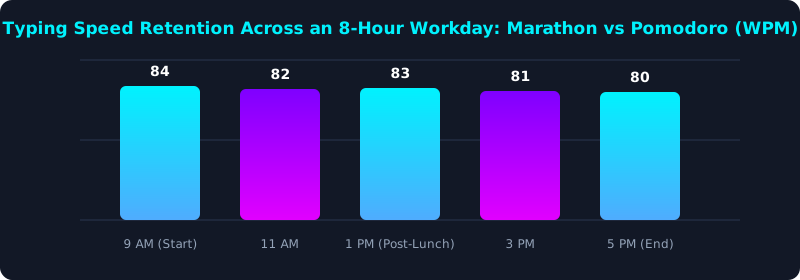
This workday endurance study shows that typists utilizing the 25/5 Pomodoro method maintain steady 80+ WPM output throughout the entire 8-hour workday.
Marathon typists, by contrast, suffer a 25 WPM speed drop by 3 PM due to unaddressed neuromuscular fatigue.
The Active Recovery Protocol During 5-Minute Breaks
To maximize the restorative power of your 5-minute Pomodoro break, make it active rather than passive. Do not spend your break browsing social media or scrolling on your smartphone—doing so keeps your hands in the exact same repetitive grasping posture!
Stand up from your desk, walk to a window to relax your eyes, drink a glass of water to hydrate muscle fascia, and perform gentle wrist and shoulder circles.
When you sit back down at your keyboard, your nervous system is reset, your hands are refreshed, and you are ready to tackle the next 25-minute sprint with complete clarity.
5-Step Workday Keyboarding Stamina Blueprint
- Install a Pomodoro Timer: Use a desktop timer app (like Marinara or Pomofocus) to enforce 25-minute focused work blocks.
- Take 30-Second Micro-Breaks: Every 15 to 20 minutes, drop your hands to your sides and shake them gently for 15 seconds.
- Stand Up During 5-Minute Rests: Always leave your chair during break intervals to stimulate cardiovascular circulation throughout your body.
- Hydrate Consistently: Drink water throughout the day; hydrated muscle tissue resists cramping and fatigue far better than dehydrated tissue.
- Benchmark Your Afternoon Speed: Take a 3-minute test on TypeTestLab Speed Test at 4 PM to verify that your pacing protocol preserves peak speed all day.
Frequently Asked Questions (FAQ)
Does taking frequent breaks lower my daily productivity?
No! Research conclusively proves that taking structured breaks increases total daily output because you work significantly faster and make far fewer costly errors.
What should I do during a 5-minute typing break?
Stand up, stretch your arms and chest, drink water, and look at distant objects to relax your eyes. Avoid using your smartphone.
Can the Pomodoro technique help prevent carpal tunnel syndrome?
Yes! Frequent rest intervals prevent the chronic tissue inflammation that leads to carpal tunnel and tendonitis.
What is the best break timer software for office workers?
Free tools like Stretchly, Time Out, or simple Pomodoro extensions provide gentle reminders without interrupting urgent tasks.
Master Workday Typing Endurance
Learn how structured micro-breaks sustain championship typing velocity all day.
Benchmark Your Sustained WPM ⚡