
How to Stop Looking Down at the Keyboard: 7 Muscle Memory Hacks
The single greatest barrier preventing typists from breaking past 40 WPM is looking down at the keyboard. Each time your eyes shift from the screen to the physical keycaps, your brain must pause text processing, realign ocular focus, locate the physical key, press it, and refocus back on the screen.
This visual shifting creates severe micro-delays that cap your typing speed and cause neck and eye fatigue.
This article presents 7 actionable muscle memory hacks designed to break the keyboard-gazing habit permanently.
📌 Key Takeaways & Executive Summary
- Global Speed Benchmark: The average unconditioned typist operates at 38–41 WPM. Mastering procedural touch typing elevates sustainable output to 65–85+ WPM.
- Accuracy Precedes Velocity: Enforcing a strict 98%+ accuracy ceiling prevents compound error cascades, allowing muscle memory to solidify faster than rushing through typos.
- Neuromuscular Chunking: High-speed typing shifts mental workload from individual letter recognition to multi-letter bi-gram and tri-gram procedural motor reflexes.
- Micro-Burst Training Model: Three focused 10-minute targeted daily sessions produce higher neuromuscular retention and lower fatigue compared to marathon practice sessions.
- Immediate Practical Application: Benchmark your baseline today using our calibrated typing engine and interactive arcade challenges to track objective progress.
The Cognitive & Physical Cost of Visual Hunting
Studies in eye-tracking ergonomics reveal that hunt-and-peck typists shift their eyes up to 120 times per minute. This constant visual oscillation consumes immense mental energy, leading to headaches, neck strain, and high error rates.
Touch typists, by contrast, maintain fixed visual gaze on screen content or source documents, executing keystrokes entirely via subconscious spatial memory.
| Hack # | Muscle Memory Hack Name | Target Mechanism | Implementation Difficulty | Expected WPM Gain |
|---|---|---|---|---|
| Hack 1 | The Keyboard Towel Cover | Forced Visual Isolation | Easy | +15 WPM |
| Hack 2 | Tactile Ridge Verification | Physical Home Row Anchoring | Easy | +10 WPM |
| Hack 3 | Blank Keycap Mod (Stealth) | Eliminates Key Legend Reliance | Moderate | +20 WPM |
| Hack 4 | Screen-Only Text Focus | Re-anchors Ocular Attention | Easy | +8 WPM |
| Hack 5 | Auditory Error Feedback | Instant Non-Visual Error Alerts | Easy | +12 WPM |
| Hack 6 | Metronome Rhythm Drills | Paces Subconscious Strokes | Moderate | +15 WPM |
| Hack 7 | Slow-Motion Flawless Practice | Consolidates Neural Pathways | Easy | +18 WPM |
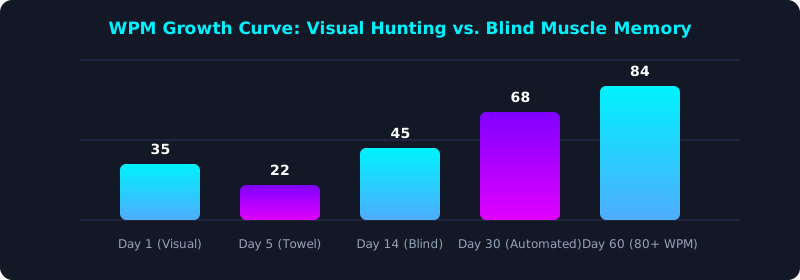
This growth curve demonstrates the initial temporary speed dip when switching to blind typing, followed by rapid, exponential WPM progression.
Re-Training Your Brain with Auditory & Tactile Cues
By replacing visual cues with tactile ridges (F and J keys) and instant audio feedback on mistakes, your brain rapidly maps key positions in 3D space, eliminating the need to look down.
5-Step Action Protocol to Break Keyboard Gazing
- Place a Towel Over Your Hands: Drape a light towel over your wrist and hands while typing to physically block keyboard view.
- Feel for F & J Tactile Ridges: Train your index fingers to find F and J by feel before keying any sentence.
- Enable Audio Error Signals: Use TypeTestLab Structured Lessons with error audio feedback enabled to receive instant non-visual alerts.
- Practice Blind Sentence Drills: Type complete sentences on TypeTestLab Speed Test without looking down once.
- Track Your Blind Net WPM: Measure your blind typing progress and generate a verified score on Official Typing Certificate.
Frequently Asked Questions (FAQ)
Why is it so hard to stop looking at the keyboard?
Looking down is a deeply ingrained visual security habit. Breaking it requires 5 to 7 days of strict visual isolation practice.
Will my typing speed drop when I stop looking down?
Yes, your speed will temporarily drop for a few days, but will quickly surpass your old visual typing speed.
Do blank keycaps help break the habit?
Yes! Stealth or blank keycaps force your brain to map keys spatially rather than visually.
How many days does it take to build blind muscle memory?
Most typists develop reliable blind muscle memory within 10 to 14 days of 15-minute daily practice.
Where can I practice blind touch typing?
Access blind typing drills and structured lessons directly on TypeTestLab Structured Lessons.
Break the Looking-Down Habit Today
Start blind muscle memory drills on TypeTestLab and unlock fast touch typing.
Start Blind Typing Drills ⚡