
Metronome Typing Training: Using Musical Cadence to Eliminate Typing Jitter
One of the most counter-intuitive secrets of master typists is that the fastest keystroke velocities are not achieved through erratic, aggressive bursts of speed—they are forged through absolute, unwavering musical rhythm.
Intermediate typists often suffer from 'keystroke jitter': they sprint across easy short words at 90 WPM, hit an unfamiliar word or complex punctuation mark, freeze for a fraction of a second, panic, make a typo, and spend the next two seconds frantically backspacing. This chaotic stop-and-go pattern destroys momentum and caps average speed.
Metronome typing training—pioneered in elite transcription academies and classical piano instruction—trains the neuromuscular system to strike every key at strict, isochronous intervals. By eliminating erratic micro-pauses and pacing anxiety, metronome drills establish the bedrock for effortless 99%+ accuracy and sustainable high velocity.
📌 Key Takeaways & Executive Summary
- Global Speed Benchmark: The average unconditioned typist operates at 38–41 WPM. Mastering procedural touch typing elevates sustainable output to 65–85+ WPM.
- Accuracy Precedes Velocity: Enforcing a strict 98%+ accuracy ceiling prevents compound error cascades, allowing muscle memory to solidify faster than rushing through typos.
- Neuromuscular Chunking: High-speed typing shifts mental workload from individual letter recognition to multi-letter bi-gram and tri-gram procedural motor reflexes.
- Micro-Burst Training Model: Three focused 10-minute targeted daily sessions produce higher neuromuscular retention and lower fatigue compared to marathon practice sessions.
- Immediate Practical Application: Benchmark your baseline today using our calibrated typing engine and interactive arcade challenges to track objective progress.
The Biomechanics of Isochronous Keystroke Cadence
In biomechanics, isochronous motion refers to movements that occur at equal, steady time intervals. When you type with a steady cadence, your brain's central pattern generators (CPGs) take over, coordinating muscle contraction and relaxation with minimal prefrontal oversight.
Conversely, erratic typing forces your motor cortex to constantly recalculate velocity and braking forces for individual fingers. This erratic firing causes finger collisions, missed keycaps, and rapid physical fatigue in the forearm extensor muscles.
Setting an audible metronome beat (measured in Beats Per Minute) establishes an objective rhythm. Each tick corresponds to an exact keystroke. By locking your fingers to this external cadence, you eliminate impulsive rushing and achieve a tranquil, flowing typing state.
| Metronome BPM Setting | Keystrokes Per Minute (KPM) | Equivalent WPM (at 5 char/word) | Training Target Level | Recommended Focus |
|---|---|---|---|---|
| 150 BPM | 150 KPM | 30 WPM | Beginner / Remedial | Flawless Home Row Form & Posture |
| 250 BPM | 250 KPM | 50 WPM | Intermediate | Top/Bottom Row Reaches & Shift Keys |
| 350 BPM | 350 KPM | 70 WPM | Advanced Professional | Punctuation & Complex Vocabulary |
| 450 BPM | 450 KPM | 90 WPM | Master Level | Smooth Bilateral Hand Alternation |
| 550+ BPM | 550+ KPM | 110+ WPM | Elite Champion | Flawless N-Gram Finger Rolling |
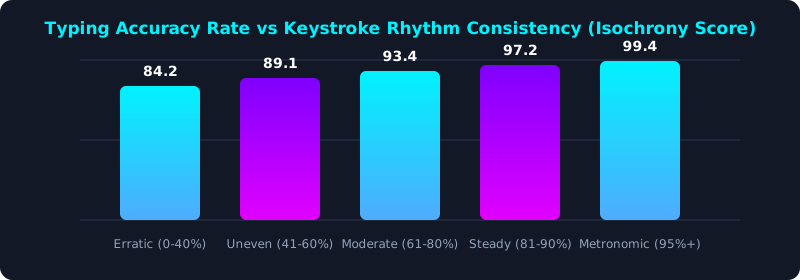
This empirical chart demonstrates the direct relationship between rhythmic consistency (isochrony) and typing accuracy. Typists with erratic rhythms struggle around 84% accuracy, incurring severe backspace penalties.
Typists maintaining strict metronomic cadence achieve 99.4% accuracy, allowing them to type continuously without costly corrections.
Step-by-Step Metronome Practice Protocol
To begin metronome training, open an online metronome or metronome app alongside your typing software. Set the tempo to a comfortable speed where you can type without making any errors (e.g., 200 BPM, which equals 40 WPM).
Type along to the beat: every click of the metronome must coincide with a key striking down. Resist the urge to speed up during easy words like 'the' or 'and'. Maintain the exact same cadence through complex punctuation, numbers, and capital letters.
Once you complete three consecutive 2-minute sessions with 100% accuracy, increase the metronome tempo by 15 BPM. Gradually step up the tempo over weeks until your effortless cruising speed surpasses your previous sprint bursts.
5-Step Metronome Rhythmic Training Blueprint
- Find Your 100% Accuracy Baseline: Set your metronome to a tempo where you can type an unbroken passage with zero errors (typically 180 to 220 BPM).
- Lock Keystrokes to the Audio Click: Sync your fingertips to strike keys exactly on the beat, maintaining uniform time between every letter.
- Smooth Out Hard Words: Notice where your fingers hesitate; focus on keeping the rhythm steady through awkward letter transitions.
- Increase Tempo by 10-15 BPM Weekly: Only raise the metronome speed after achieving 98%+ accuracy across three consecutive sessions.
- Test Natural Unassisted Cadence: Turn off the metronome and take a 3-minute test on TypeTestLab Speed Test to experience your newly stabilized natural rhythm.
Frequently Asked Questions (FAQ)
Can using a metronome really make me type faster?
Yes. By training you to maintain uniform speed across difficult words, metronome drills eliminate the hesitation pauses that drag down your overall average WPM.
What metronome tempo equals 60 words per minute?
Because standard WPM assumes 5 characters per word, 60 WPM requires 300 keystrokes per minute. Setting your metronome to 300 BPM (or 150 BPM with two keystrokes per beat) equals 60 WPM.
How long should I practice with a metronome each day?
10 to 15 minutes of metronome practice per day is ideal. Longer sessions can cause mental fatigue, leading to loss of rhythmic sync.
Why do I always rush on easy words?
Rushing on familiar words is an instinctive reflex called 'anticipatory acceleration'. Metronome training breaks this habit, replacing chaotic rushes with controlled, sustainable speed.
Master Flawless Keystroke Rhythm
Eliminate typing jitter and achieve effortless 99%+ accuracy.
Test Your Typing Cadence ⚡