
N-Key Rollover (NKRO) & Anti-Ghosting: Why Keyboard Hardware Matters
Have you ever experienced dropped letters or unwanted phantom characters while typing rapidly? The culprit may not be your fingers, but hardware limitations in cheap membrane keyboards.
High-speed typists keying past 80 WPM execute rapid overlapping keypresses. Without proper N-Key Rollover (NKRO) and anti-ghosting circuitry, membrane keyboards miss keystrokes or register ghost keys.
This technical guide explains NKRO, 6KRO, matrix ghosting, switch debounce delays, and why quality keyboard hardware is essential for accuracy.
📌 Key Takeaways & Executive Summary
- Global Speed Benchmark: The average unconditioned typist operates at 38–41 WPM. Mastering procedural touch typing elevates sustainable output to 65–85+ WPM.
- Accuracy Precedes Velocity: Enforcing a strict 98%+ accuracy ceiling prevents compound error cascades, allowing muscle memory to solidify faster than rushing through typos.
- Neuromuscular Chunking: High-speed typing shifts mental workload from individual letter recognition to multi-letter bi-gram and tri-gram procedural motor reflexes.
- Micro-Burst Training Model: Three focused 10-minute targeted daily sessions produce higher neuromuscular retention and lower fatigue compared to marathon practice sessions.
- Immediate Practical Application: Benchmark your baseline today using our calibrated typing engine and interactive arcade challenges to track objective progress.
Understanding Key Matrix Ghosting & Rollover
Membrane keyboards connect keys in a shared electrical matrix grid. When three adjacent keys are pressed simultaneously, cheap matrices can misinterpret signals, causing a 'ghost' keypress or ignoring inputs ('key blocking').
N-Key Rollover (NKRO) equips every key switch with a dedicated diode, allowing the keyboard to register an unlimited number of simultaneous keypresses accurately.
| Rollover Tech Specification | Simultaneous Keys Registered | Ghosting Risk | Hardware Architecture | Typing Suitability |
|---|---|---|---|---|
| 2-Key Rollover (2KRO) | Max 2 Keys | High (Keys Block) | Cheap Membrane Matrix | Unsuitable for High-Speed Typing |
| 6-Key Rollover (6KRO) | Max 6 Keys + Modifiers | Low | Standard USB HID Specification | Good for Standard Office Work |
| Full N-Key Rollover (NKRO) | Unlimited Keys Simultaneously | Zero Ghosting | Individual Diode per Switch | Optimal for Fast Touch Typists & Coders |
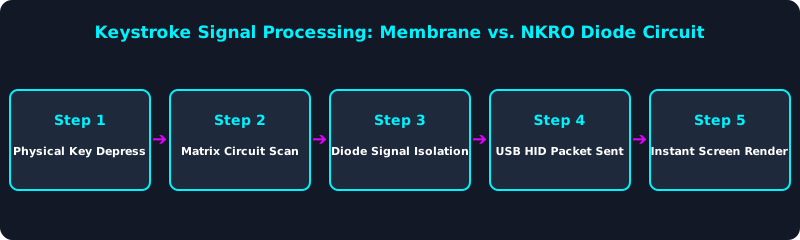
This circuit diagram illustrates how NKRO diodes isolate individual key signals to prevent key drops.
Switch Debounce Time & Polling Rates
Mechanical switches use metal contacts that 'bounce' rapidly upon impact. Keyboard microcontrollers use debounce algorithms (typically 1 to 5 ms) to clean signals. Higher USB polling rates (1000Hz) ensure sub-millisecond latency.
5 Steps to Verify Your Keyboard Hardware
- Run an NKRO Key Rollover Test: Test your keyboard matrix using TypeTestLab Structured Lessons.
- Test Simultaneous Multi-Key Chords: Press 6 keys simultaneously to check for key blocking.
- Upgrade to a Mechanical Keyboard with NKRO: Select a mechanical keyboard equipped with full NKRO over USB.
- Clean Switches to Eliminate Debounce Typos: Maintain clean switches to avoid double-character chatter.
- Benchmark Hardware Net WPM: Measure your hardware performance on TypeTestLab Speed Test.
Frequently Asked Questions (FAQ)
What is N-Key Rollover (NKRO)?
NKRO is a hardware feature allowing a keyboard to register every keypress simultaneously without dropping inputs.
What is keyboard ghosting?
Ghosting occurs when pressing multiple keys triggers an unpressed 'phantom' character due to cheap matrix wiring.
Is 6KRO enough for fast typing?
6KRO (6-key rollover) is sufficient for most typists, but full NKRO is preferred for extreme speeds and gaming.
Do laptop keyboards have NKRO?
Most laptop keyboards use cheap 2KRO or 6KRO membrane matrices and may drop keys during high-speed typing.
Where can I test my keyboard for ghosting?
Run hardware rollover tests on TypeTestLab Structured Lessons.
Test Your Keyboard Hardware Today
Check your keyboard for ghosting and dropped keys on TypeTestLab.
Start Hardware Rollover Test ⚡