
Logistics, Supply Chain & Shipping Clerk Typing Requirements
In global supply chain management, freight forwarding, and warehouse distribution operations (including Amazon, DHL, FedEx, UPS, and C.H. Robinson), logistics coordinators and shipping clerks operate at the pulse of commerce.
From generating Bills of Lading (BOL), commercial customs invoices, and airway bills to managing Warehouse Management Systems (WMS) and Transportation Management Systems (TMS), clerks handle thousands of tracking numbers, container IDs, and tariff classifications every shift.
A single typographical error in a Harmonized System (HS) customs code or container number can cause catastrophic shipping delays, port demurrage penalties, or misrouted cargo. Pre-employment testing in the logistics sector demands fast, flawless alphanumeric data entry.
📌 Key Takeaways & Executive Summary
- Global Speed Benchmark: The average unconditioned typist operates at 38–41 WPM. Mastering procedural touch typing elevates sustainable output to 65–85+ WPM.
- Accuracy Precedes Velocity: Enforcing a strict 98%+ accuracy ceiling prevents compound error cascades, allowing muscle memory to solidify faster than rushing through typos.
- Neuromuscular Chunking: High-speed typing shifts mental workload from individual letter recognition to multi-letter bi-gram and tri-gram procedural motor reflexes.
- Micro-Burst Training Model: Three focused 10-minute targeted daily sessions produce higher neuromuscular retention and lower fatigue compared to marathon practice sessions.
- Immediate Practical Application: Benchmark your baseline today using our calibrated typing engine and interactive arcade challenges to track objective progress.
Supply Chain Data Velocity & Alphanumeric Accuracy
Freight dispatchers and logistics clerks operate under tight dock schedules. When a linehaul semi-truck arrives at a warehouse bay, the dispatch clerk must verify shipping orders, assign dock doors, key trailer numbers, and issue driver paperwork within minutes to prevent yard congestion.
Logistics roles generally require a baseline typing speed of 40 to 50 Net WPM, combined with an intense emphasis on alphanumeric and 10-key numeric pad velocity (typically 8,000 to 10,000 KPH).
Clerks must seamlessly alternate between typing driver instructions and entering 12-digit tracking numbers without losing their place on physical bills or dual digital dispatch monitors.
| Supply Chain Role | Minimum QWERTY WPM | 10-Key Numeric KPH | Required Accuracy | Core Logistics Tasks |
|---|---|---|---|---|
| Freight Dispatcher | 50 WPM | 8,500 KPH | 98.5% | Load Scheduling, Driver Communication, TMS |
| Warehouse Shipping / Receiving Clerk | 40 WPM | 9,000 KPH | 98.0% | Bills of Lading (BOL), Inventory Entry, WMS |
| Customs Brokerage Clerk | 50 WPM | 10,000 KPH | 99.2% | HS Tariff Codes, Import Entry, Documentation |
| Inventory Control Specialist | 45 WPM | 10,500 KPH | 99.5% | SKU Reconciliation, Cycle Count Entry |
| Supply Chain Operations Specialist | 55 WPM | 9,000 KPH | 98.5% | Carrier Performance Tracking, Client Memos |
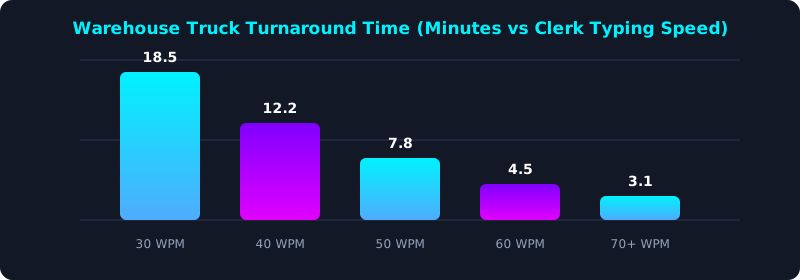
This supply chain operational graph illustrates driver gate check-in turnaround times (in minutes) based on clerk data entry speed.
Clerks typing at 60+ WPM process check-ins in under 5 minutes, eliminating costly truck idling and gate congestion.
Ergonomics for Industrial & Warehouse Workstations
Shipping and receiving desks in distribution centers are often located in high-traffic, noisy warehouse environments with non-standard standing desks or industrial computer kiosks.
Clerks frequently type while standing or wearing thin industrial gloves. Utilizing industrial membrane or tactile mechanical keyboards with durable keycaps ensures accurate actuation even in dusty warehouse settings.
Developing touch-typing muscle memory allows warehouse clerks to keep their eyes on incoming freight pallets and barcode labels while keying quantities without hesitation.
5-Step Logistics Keyboarding Mastery Blueprint
- Test Your Industrial Speed: Take a 5-minute timed typing assessment on TypeTestLab Speed Test with alphanumeric strings to simulate shipping orders.
- Master Alphanumeric Tracking Codes: Practice keying mixed letter-and-number sequences (e.g., 1Z9999999999999999, MAEU1234567) without looking down.
- Drill 10-Key SKU Quantity Entry: Practice blind numeric keypad drills to enter weights, pallet counts, and dimensions at 9,000+ KPH.
- Simulate Warehouse Distractions: Practice typing drills with ambient noise to build focus in bustling distribution environments.
- Obtain a Verified Logistics Certificate: Earn an Official Typing Certificate to validate your data entry credentials for supply chain employers.
Frequently Asked Questions (FAQ)
Do logistics companies test typing speed during job interviews?
Yes. Freight forwarders and distribution centers universally administer pre-employment data entry tests evaluating both QWERTY text and 10-key numeric keypad speed.
What is a good 10-key speed for a shipping and receiving clerk?
A competitive standard is 8,500 to 10,000 KPH with 98%+ accuracy.
How do typos impact supply chain operations?
A single incorrect digit in a container number or customs declaration can cause shipments to be impounded at border ports, triggering thousands of dollars in demurrage fines.
How can a warehouse clerk learn touch typing quickly?
Practicing 15 minutes a day with TypeTestLab structured lessons typically increases typing speed by 15-20 WPM in just 4 to 5 weeks.
Boost Your Supply Chain Career
Master the high-speed alphanumeric and 10-key typing skills demanded in modern logistics.
Take Logistics Data Entry Test ⚡