
HR & Talent Recruiter Typing Speed: Standards for Screening & Candidate Notes
In corporate talent acquisition, human resources departments, and executive search firms across the US, UK, and Canada, HR professionals manage an immense volume of written communication daily. From conducting candidate phone screenings and writing job descriptions to managing Applicant Tracking Systems (ATS) and documenting performance reviews, keyboard velocity is a primary operational driver.
During live phone and video interviews, recruiters must engage candidates in active conversation while simultaneously typing comprehensive, objective interview scorecards in tools like Greenhouse, Lever, or Workday. If a recruiter types slowly or hunts for keys, they either lose eye contact and rapport with the candidate or fail to capture critical answers.
While general clerical benchmarks cite 40 WPM as acceptable, elite technical recruiters and HR business partners maintain 60 to 75 WPM to streamline candidate documentation and maintain peak daily hiring velocity.
📌 Key Takeaways & Executive Summary
- Global Speed Benchmark: The average unconditioned typist operates at 38–41 WPM. Mastering procedural touch typing elevates sustainable output to 65–85+ WPM.
- Accuracy Precedes Velocity: Enforcing a strict 98%+ accuracy ceiling prevents compound error cascades, allowing muscle memory to solidify faster than rushing through typos.
- Neuromuscular Chunking: High-speed typing shifts mental workload from individual letter recognition to multi-letter bi-gram and tri-gram procedural motor reflexes.
- Micro-Burst Training Model: Three focused 10-minute targeted daily sessions produce higher neuromuscular retention and lower fatigue compared to marathon practice sessions.
- Immediate Practical Application: Benchmark your baseline today using our calibrated typing engine and interactive arcade challenges to track objective progress.
Live Interview Multi-Tasking & ATS Documentation Velocity
Recruiting involves a delicate balance of interpersonal empathy and rigorous documentation. In modern employment litigation environments, accurate interview notes are essential legal safeguards against discrimination claims, requiring recruiters to record candidate answers with near-verbatim clarity.
A recruiter who types at 65 WPM can easily capture structured candidate responses, evaluate technical competencies, and assign scorecard ratings during a 30-minute screening call with 5 minutes of post-call buffer time. A recruiter typing at 35 WPM must spend an extra 15 to 20 minutes after every interview trying to reconstruct notes from memory.
Over the course of 8 back-to-back screening calls in a single workday, this mechanical bottleneck wastes up to 2.5 hours of valuable recruiting time.
| HR & Recruiting Role | Minimum Hiring WPM | Target Benchmark WPM | Primary System / Platform | Daily Documentation Burden |
|---|---|---|---|---|
| Technical Talent Recruiter | 55 WPM | 70+ WPM | Greenhouse, Lever, LinkedIn Recruiter | 8-12 Screening Scorecards |
| HR Generalist / HRBP | 50 WPM | 65 WPM | Workday, BambooHR, ADP | Policy Memos, Employee Relations |
| Recruiting Coordinator | 50 WPM | 65 WPM | Google Workspace, Calendly, ATS | High-Volume Candidate Logistics |
| Compensation & Benefits Analyst | 45 WPM | 60 WPM | Excel, Payroll Systems, 10-Key | Salary Modeling, Benefit Records |
| Employee Relations Specialist | 55 WPM | 75 WPM | Case Management, Legal Memos | Formal Workplace Investigation Notes |
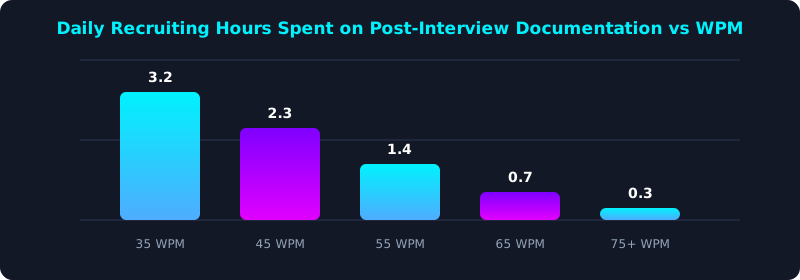
This workplace efficiency chart shows the average daily hours HR professionals spend typing candidate notes after interviews across different typing speed tiers.
Recruiters typing at 70+ WPM complete their notes in real time during the call, saving nearly 3 hours every day to source top candidates and close offers.
Professional Ergonomics for Long Recruiting Days
Talent acquisition professionals spend up to 7 hours a day keying messages on LinkedIn, drafting offer letters, and messaging on Slack. This constant repetitive motion puts recruiters at high risk for carpal tunnel syndrome and forearm strain.
Adopting an ergonomic keyboard with split key wells and cushioned wrist rests maintains neutral forearm alignment, allowing recruiters to maintain high typing velocity without physical discomfort.
Mastering touch typing eliminates the constant downward head bobbing between the screen and keycaps, preventing chronic cervical neck strain and tension headaches.
5-Step HR Professional Keyboarding Acceleration Blueprint
- Measure Your Real-Time Typing Speed: Take a 3-minute evaluation on TypeTestLab Speed Test to gauge your live WPM and identify error trends.
- Practice Conversational Note-Taking: Listen to recorded interviews or podcasts and practice taking bulleted notes without looking at your keyboard.
- Master ATS Formatting Shortcuts: Learn markdown and ATS text shortcuts to format interview notes instantly with bold tags and lists.
- Adopt Ergonomic Typing Habits: Keep wrists straight, float your palms lightly, and take 30-second micro-breaks between interview calls.
- Earn an Official HR Skill Certificate: Generate an Official Typing Certificate to validate your documentation efficiency for HR promotions.
Frequently Asked Questions (FAQ)
Do corporate HR roles require formal typing tests during hiring?
Many corporate HR departments test entry-level HR coordinators and recruiting coordinators on typing speed (typically requiring 50+ WPM) to ensure they can manage high-volume scheduling and correspondence.
What is the best way to type notes during an interview without distracting the candidate?
Use a quiet mechanical keyboard with silenced switches or a soft laptop keyboard, and position your screen so you can maintain natural eye contact while touch typing blindly.
How many words per minute do executive recruiters type?
Top executive search consultants typically type at 65 to 80 WPM, enabling rapid transcription of board-level executive interviews.
How can an HR coordinator improve from 45 to 65 WPM?
Practicing 15 minutes a day with TypeTestLab structured lessons focusing on accuracy and home row discipline typically yields a 20 WPM increase in 4 to 6 weeks.
Elevate Your Talent Acquisition Efficiency
Master rapid interview documentation and streamline your recruiting workflow.
Benchmark Your Recruiting Typing Speed ⚡