
Insurance Claims Adjuster Typing Tests: Documentation Speed Standards
In the commercial and personal insurance industry across the United States, United Kingdom, and Canada (including State Farm, Geico, Progressive, Allstate, and Travelers), claims adjusters and examiners represent the front line of catastrophe recovery and loss mitigation.
Following automobile accidents, hurricanes, residential fires, or commercial property damage, adjusters conduct recorded telephone interviews with policyholders, examine police accident reports, and inspect contractor repair estimates. Every detail must be meticulously documented in claims management software (such as Guidewire, Mitchell, or CCC ONE).
Because insurance files are legally binding records subject to civil litigation, adjusters must record factual loss narratives with extreme speed and precision. Pre-employment screening routinely requires 45 to 55 Net WPM with strict accuracy cutoffs.
📌 Key Takeaways & Executive Summary
- Global Speed Benchmark: The average unconditioned typist operates at 38–41 WPM. Mastering procedural touch typing elevates sustainable output to 65–85+ WPM.
- Accuracy Precedes Velocity: Enforcing a strict 98%+ accuracy ceiling prevents compound error cascades, allowing muscle memory to solidify faster than rushing through typos.
- Neuromuscular Chunking: High-speed typing shifts mental workload from individual letter recognition to multi-letter bi-gram and tri-gram procedural motor reflexes.
- Micro-Burst Training Model: Three focused 10-minute targeted daily sessions produce higher neuromuscular retention and lower fatigue compared to marathon practice sessions.
- Immediate Practical Application: Benchmark your baseline today using our calibrated typing engine and interactive arcade challenges to track objective progress.
The Claims Narrative Documentation Burden
Insurance claims examiners handle active caseloads ranging from 30 to 80 open claims simultaneously. Each claim file requires comprehensive first notice of loss (FNOL) summaries, liability determinations, damage descriptions, and ongoing file notes.
An adjuster who types at 40 WPM requires nearly 45 minutes to draft a detailed liability investigation memo for a multi-vehicle collision. An adjuster typing at 65 WPM completes the same legal summary in under 20 minutes, allowing them to adjudicate claims faster and issue settlements promptly.
Furthermore, adjusters frequently take recorded recorded audio statements from witnesses. Being able to type notes at 60+ WPM during the live call eliminates hours of post-interview transcription.
| Insurance Claims Role | Minimum Hiring WPM | Benchmark Professional WPM | Required Accuracy | Primary Documentation Task |
|---|---|---|---|---|
| Auto Property Claims Adjuster | 45 WPM | 60 WPM | 96% | Accident Descriptions & Repair Notes |
| Bodily Injury Claims Examiner | 50 WPM | 65 WPM | 98% | Medical Record Summaries & Liability |
| Catastrophe (CAT) Field Adjuster | 45 WPM | 60 WPM | 95% | On-Site Property Inspection Estimates |
| Workers' Compensation Adjuster | 50 WPM | 70 WPM | 98% | Detailed Medical & Wage Disability Notes |
| Claims Intake / FNOL Representative | 45 WPM | 55 WPM | 96% | Rapid Initial Loss Triage & Call Intake |
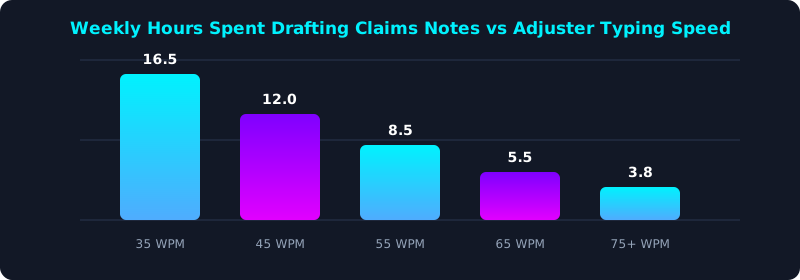
This claims operations chart shows weekly hours spent typing file documentation across different adjuster typing speed tiers based on a 50-claim weekly caseload.
Adjusters typing at 65+ WPM save over 6 hours every week compared to 45 WPM peers, directly accelerating claims closure rates and lowering loss adjustment expenses.
Field Laptops & Mobile Claim Adjuster Ergonomics
Field property and catastrophe adjusters face unique physical working conditions. Often working out of temporary catastrophe trailers or typing on laptops balanced on steering wheels and clipboards, adjusters frequently suffer acute wrist strain.
Using lightweight portable laptops with responsive scissor-switch keys allows field adjusters to enter estimates and damage notes quickly without pounding keys.
Developing blind touch typing ensures adjusters can keep their eyes on property damage photographs, diagrams, and police reports while keying descriptions effortlessly.
5-Step Insurance Adjuster Keyboarding Preparation Blueprint
- Take an Insurance Simulation Test: Complete a 5-minute typing test on TypeTestLab Speed Test to benchmark your baseline speed and error deductions.
- Practice Legal & Insurance Vocabulary: Drill insurance terminology (subrogation, indemnification, tortfeasor, deductible) until typing sequences automate.
- Master Alphanumeric Policy Numbers: Practice keying policy codes, VIN numbers, and decimal claim amounts without glancing at keys.
- Improve Audio Statement Speed: Listen to recorded interviews and practice capturing loss narratives and witness statements in real time.
- Earn an Official Claims Certificate: Generate an Official Typing Certificate to attach to your insurance career application.
Frequently Asked Questions (FAQ)
Do major insurance companies test typing speed during interviews?
Yes. Companies like Geico, Progressive, and State Farm universally administer pre-employment typing and data entry tests for customer service, FNOL, and adjuster roles, typically requiring 45+ WPM.
What typing accuracy rate is required for insurance adjusters?
Because claim documentation is used in legal proceedings, insurance employers typically enforce a strict 96% to 98% accuracy cutoff.
Can voice dictation software replace typing for claims adjusters?
While speech-to-text tools are increasingly used, adjusters still rely on high-speed typing for editing, entering alphanumeric claim codes, and handling live confidential phone calls.
How quickly can a new claims trainee reach 55 WPM?
With 15 to 20 minutes of daily deliberate touch-typing practice on TypeTestLab, trainees typically progress from 35 WPM to 55+ WPM in 4 to 5 weeks.
Excel in Your Insurance Claims Career
Master the high-speed typing and documentation skills demanded by top insurers.
Take Claims Adjuster Typing Test ⚡