
Typing vs Handwriting for College Lecture Notes: Speed, Retention & Cognitive Load
In university lecture halls across Harvard, Oxford, Stanford, and major global institutions, the debate over whether laptops or traditional paper notebooks yield superior academic performance remains fiercely contested among cognitive scientists and educators.
Typing on a laptop offers undeniable velocity: an experienced typist can capture 60 to 80 Words Per Minute, allowing nearly verbatim transcription of fast-paced professorial lectures. Conversely, manual handwriting tops out at a modest 20 to 25 WPM, forcing students to synthesize and condense concepts on the fly.
However, seminal research by Mueller and Oppenheimer revealed that mindless verbatim transcription can actually impair conceptual comprehension compared to the generative processing required by longhand notes. This comprehensive report explores the mechanical capture trade-offs and outlines a high-performance hybrid workflow that maximizes both speed and cognitive retention.
📌 Key Takeaways & Executive Summary
- Global Speed Benchmark: The average unconditioned typist operates at 38–41 WPM. Mastering procedural touch typing elevates sustainable output to 65–85+ WPM.
- Accuracy Precedes Velocity: Enforcing a strict 98%+ accuracy ceiling prevents compound error cascades, allowing muscle memory to solidify faster than rushing through typos.
- Neuromuscular Chunking: High-speed typing shifts mental workload from individual letter recognition to multi-letter bi-gram and tri-gram procedural motor reflexes.
- Micro-Burst Training Model: Three focused 10-minute targeted daily sessions produce higher neuromuscular retention and lower fatigue compared to marathon practice sessions.
- Immediate Practical Application: Benchmark your baseline today using our calibrated typing engine and interactive arcade challenges to track objective progress.
The Verbatim Transcription Trap: Cognitive Science Analysis
When college students type lecture notes at high speeds (70+ WPM), their brains frequently operate in a passive 'stenographic reflex' mode. Auditory signals flow from the ears into the motor cortex and directly out through the fingertips without undergoing deep semantic processing in the prefrontal cortex.
On post-lecture conceptual evaluations, students who took verbatim laptop notes frequently score lower on complex application questions than longhand note-takers, even though laptop notes contain twice as many total words.
However, in fast-moving STEM courses (engineering, organic chemistry, advanced statistics) and law school lectures where professors cite rapid statutes, case law precedents, and data formulas, the low capture speed of handwriting causes students to miss critical technical details entirely.
| Note-Taking Modality | Average Capture Speed | Verbatim Overlap % | Immediate Retention | Long-Term Exam Utility |
|---|---|---|---|---|
| Fast Laptop Touch Typing | 65 - 80 WPM | 78% | Moderate (Passive) | High (Searchable & Complete) |
| Average Laptop Typing | 40 - 50 WPM | 52% | Moderate | Moderate (Gaps Occur) |
| Traditional Longhand Handwriting | 18 - 25 WPM | 14% | High (Generative) | Low (Incomplete & Slow Review) |
| Tablet Stylus Digital Handwriting | 20 - 28 WPM | 18% | High (Generative) | Moderate (Searchable Handwriting) |
| Hybrid Typist (Bullet Synthesis) | 55 - 70 WPM | 32% | Very High (Optimal) | Very High (Synthesized & Digital) |
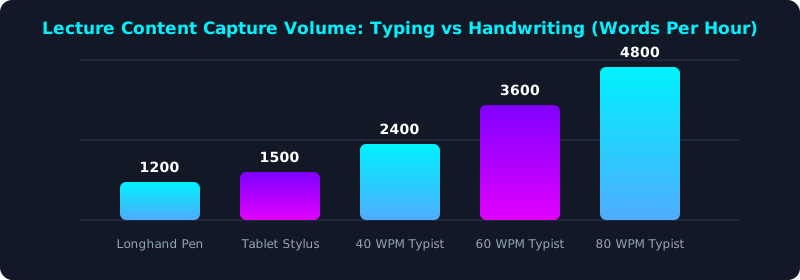
This visual graph demonstrates the total raw words captured during a typical 60-minute university lecture across different note-taking methods. Fast typists capture over 3 to 4 times more content than longhand note-takers.
By adopting a synthesized bullet-point framework rather than verbatim copying, high-speed typists capture all vital data while preserving the cognitive processing benefits of active synthesis.
The High-Performance Hybrid Note-Taking Framework
The most successful undergraduate and graduate scholars do not choose between typing and synthesis—they merge both through deliberate methodology. Using structured frameworks like the Cornell Method or progressive summarization, fast typists capture comprehensive outlines during class and synthesize key insights during review.
Having a typing speed of 60+ WPM is essential for this approach: it allows you to record an intricate professor quote, code snippet, or historical citation in seconds, freeing up mental bandwidth to listen attentively to the instructor's next point.
Organizing notes digitally inside markdown editors or knowledge tools (Obsidian, Notion, OneNote) also provides instant searchability across semesters, revolutionizing final exam preparation.
5-Step Master Plan for University Laptop Note-Taking
- Build 60+ WPM Typing Velocity: Eliminate transcription lag by training on TypeTestLab Speed Test until your finger movements require zero conscious effort.
- Adopt the Cornell Digital Template: Divide your digital document into Notes, Cues/Keywords, and a 2-sentence Summary section.
- Ban Mindless Verbatim Copying: Force yourself to rephrase the lecturer's ideas into concise bullet points rather than word-for-word transcriptions.
- Master Markdown Shortcuts: Learn rapid headings (`#`), bullet (`*`), and bold (`**`) syntax so your formatting never slows your typing.
- Conduct Same-Day 5-Minute Reviews: Spend 5 minutes after class highlighting core concepts and summarizing the day's lecture.
Frequently Asked Questions (FAQ)
Should I switch back to handwriting if my typing notes feel passive?
Not necessarily. Instead of switching back to slow handwriting, modify your typing style: write summaries in your own words and use formatting shortcuts to create active outlines rather than transcription transcripts.
What typing speed do I need to keep up with a college professor?
Most college professors speak at 120 to 150 words per minute. A typing speed of 55 to 65 WPM is ideal for summarizing their speech in real time without falling behind.
Are mechanical keyboards allowed in college lecture halls?
Generally no. Clicky mechanical switches (like Cherry MX Blue) create loud noise that disrupts surrounding classmates. Use silent membrane, scissor-switch, or silenced linear switches in academic environments.
How can students improve typing speed during the semester?
Practicing just 10 minutes every morning on TypeTestLab modules can increase your speed by 15-20 WPM within a month without interfering with coursework.
Upgrade Your College Lecture Speed
Build the keyboard velocity you need to capture complex lectures with ease.
Benchmark Your Note-Taking Speed ⚡