

AP Exam Digital Testing: Free-Response Typing Speed & Keyboard Readiness
The College Board's comprehensive rollout of digital testing across the Advanced Placement (AP) program has fundamentally transformed how high school students sit for competitive college-credit exams across the United States, Canada, and international schools.
Beginning in 2025 and 2026, core humanities and social science exams—including AP US History (APUSH), AP European History, AP World History, AP English Literature, and AP English Language—mandate that students type their Document-Based Questions (DBQs), Long Essay Questions (LEQs), and Free-Response Questions (FRQs) using computerized testing software.
Earning an elite score of 5 on an AP humanities exam requires synthesizing complex historical documents, forming nuanced arguments, and producing 800 to 1,200 words of analytical prose within strict 40 to 45-minute windows. A student's typing velocity directly governs whether they finish their synthesis or leave valuable points on the table.
📌 Key Takeaways & Executive Summary
- Global Speed Benchmark: The average unconditioned typist operates at 38–41 WPM. Mastering procedural touch typing elevates sustainable output to 65–85+ WPM.
- Accuracy Precedes Velocity: Enforcing a strict 98%+ accuracy ceiling prevents compound error cascades, allowing muscle memory to solidify faster than rushing through typos.
- Neuromuscular Chunking: High-speed typing shifts mental workload from individual letter recognition to multi-letter bi-gram and tri-gram procedural motor reflexes.
- Micro-Burst Training Model: Three focused 10-minute targeted daily sessions produce higher neuromuscular retention and lower fatigue compared to marathon practice sessions.
- Immediate Practical Application: Benchmark your baseline today using our calibrated typing engine and interactive arcade challenges to track objective progress.
The DBQ & LEQ Math: Why 30 WPM Guarantees a Low Score
Consider the rigorous time constraints of the AP US History DBQ: students receive exactly 60 minutes, which includes a mandatory 15-minute document reading and sourcing period. This leaves precisely 45 minutes of active writing time to analyze seven historical documents, formulate a thesis, supply outside historical evidence, and construct a multi-page essay.
A student typing at 30 WPM would need 30 minutes of continuous, uninterrupted keystrokes just to produce an average 900-word DBQ. This leaves almost no time to re-examine document excerpts, cross-reference evidence, or refine analytical claims.
In contrast, a student who types at 60 WPM can compose 900 words in just 15 minutes of net typing time. This leaves a massive 30-minute buffer to carefully organize arguments, cite complex historical context, and proofread for sophisticated rhetorical depth.
| AP Exam Subject | Typical FRQ Word Requirement | Writing Time Window | Minimum Passing WPM | Score 5 Target WPM |
|---|---|---|---|---|
| AP US History (APUSH) DBQ | 900 - 1,200 Words | 45 Minutes | 45 WPM | 65+ WPM |
| AP World History LEQ | 750 - 950 Words | 40 Minutes | 40 WPM | 60+ WPM |
| AP English Language (Synthesis) | 800 - 1,100 Words | 40 Minutes | 45 WPM | 65+ WPM |
| AP European History FRQ | 800 - 1,000 Words | 40 Minutes | 42 WPM | 60+ WPM |
| AP Government Argument Essay | 500 - 700 Words | 40 Minutes | 35 WPM | 50+ WPM |
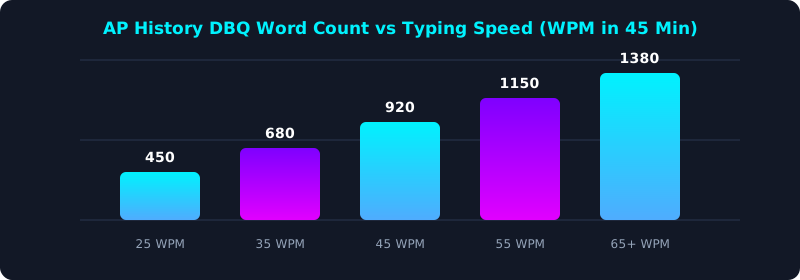
This chart illustrates total achievable word counts during a 45-minute AP DBQ essay window across different typing speeds (accounting for 15 minutes of outlining).
Notice that students typing under 35 WPM struggle to break 700 words, making it virtually impossible to thoroughly source all seven required historical documents.
Mastering the Bluebook Testing Application Interface
Digital AP exams run inside the College Board's proprietary Bluebook testing application. The interface provides basic editing functions (cut, copy, paste, undo) but entirely strips out spellcheck, grammar correction, and word prediction.
Students who rely heavily on modern smartphone auto-correct often face a harsh reality when practicing on Bluebook: every miskey remains exactly as typed unless manually backspaced and re-entered.
Practicing on standard school Chromebooks or laptops allows students to familiarize themselves with the flat chiclet keyboard feel and practice navigating text blocks using standard keyboard shortcuts (Shift + Arrow keys, Ctrl + Backspace).
5-Step AP Digital Exam Keyboarding Preparation Protocol
- Benchmark Your Sustained WPM: Take a 5-minute typing test on TypeTestLab Speed Test to assess your sustained typing endurance under timed pressure.
- Practice Document-Quoting Drills: Drill typing with quotation marks, parentheses, and document citations without glancing down at the keys.
- Simulate Timed DBQ Prompts: Set a 45-minute countdown and practice drafting complete essays directly into a plain text editor.
- Eliminate Backspace Spam: Train yourself to hit backspace once or twice with deliberate precision rather than holding it down frantically.
- Certify Your College Readiness: Earn an Official Typing Certificate showing 60+ WPM to ensure your mechanical skills are college-exam ready.
Frequently Asked Questions (FAQ)
Can I write my AP essays by hand if I prefer handwriting?
In schools designated for digital AP testing, all students must type their responses unless they have an approved College Board SSD accommodation requiring paper testing.
Does the Bluebook testing app have a word count tool?
Yes, the Bluebook application displays a live word count indicator at the bottom of the free-response typing box so students can monitor their essay depth.
Do AP graders deduct points for spelling mistakes?
AP readers do not deduct points for occasional misspellings as long as the student's argument is understandable. However, severe typing errors that obscure meaning can cost points on rubric scoring.
How can an AP student increase their typing speed from 40 to 60 WPM before May?
Dedicate 15 minutes every afternoon to TypeTestLab exercises. Consistent daily practice routinely delivers a 20 WPM improvement in 6 to 8 weeks.
Score a 5 on Your Digital AP Exams
Build fast, fatigue-free keyboard skills to dominate your DBQs and analytical essays.
Test Your AP Typing Speed ⚡