
Average Typing Speed for High School & College Students
In contemporary secondary and higher education, student academic success depends heavily on keyboarding speed. From completing timed online examinations and AP essays to writing college research papers, typing velocity directly impacts student efficiency and grades.
This empirical report investigates typing speed standards among high school students (ages 13–17) and undergraduate college students (ages 18–22) across the US, UK, and Canada, highlighting curriculum shifts and digital study strategies.
📌 Key Takeaways & Executive Summary
- Global Speed Benchmark: The average unconditioned typist operates at 38–41 WPM. Mastering procedural touch typing elevates sustainable output to 65–85+ WPM.
- Accuracy Precedes Velocity: Enforcing a strict 98%+ accuracy ceiling prevents compound error cascades, allowing muscle memory to solidify faster than rushing through typos.
- Neuromuscular Chunking: High-speed typing shifts mental workload from individual letter recognition to multi-letter bi-gram and tri-gram procedural motor reflexes.
- Micro-Burst Training Model: Three focused 10-minute targeted daily sessions produce higher neuromuscular retention and lower fatigue compared to marathon practice sessions.
- Immediate Practical Application: Benchmark your baseline today using our calibrated typing engine and interactive arcade challenges to track objective progress.
Student WPM Benchmarks across Educational Levels
Despite growing up as digital natives, many modern students lack formal touch-typing training due to the prevalence of mobile smartphones and tablets in early childhood.
High school freshmen average 34 WPM, rising to 41 WPM by senior year. College undergraduates achieve an average of 46 WPM. Students who take formal keyboarding courses average 58 WPM—a massive 12 WPM advantage over self-taught peers.
| Academic Grade Level | Average Student WPM | Touch Typing Adoption | Average Essay Completion Time (1,000 Words) |
|---|---|---|---|
| Middle School (Grades 6-8) | 28 WPM | 25% | 35.7 Minutes |
| High School Freshmen (Grade 9) | 34 WPM | 38% | 29.4 Minutes |
| High School Seniors (Grade 12) | 41 WPM | 52% | 24.3 Minutes |
| College Undergraduates (Freshman-Senior) | 46 WPM | 68% | 21.7 Minutes |
| Graduate & Professional Students | 54 WPM | 81% | 18.5 Minutes |
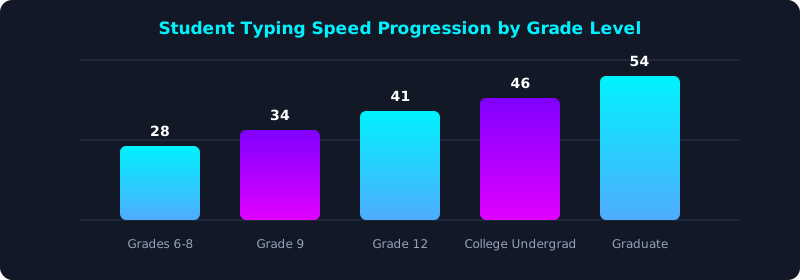
This progress chart highlights the clear correlation between academic advancement, touch-typing mastery, and increased WPM output.
The Academic Impact of Touch Typing on Exam Performance
During timed exams like the SAT, GRE, or university finals, slow typing creates cognitive friction, consuming working memory that should be dedicated to analytical thinking.
Students who touch-type at 60+ WPM complete written essay prompts 40% faster, leaving ample time for proofreading and structural revision.
5-Step Student Typing Improvement Blueprint
- Replace Thumb Typing with 10-Finger Touch Typing: Commit 15 minutes daily to TypeTestLab Structured Lessons.
- Ditch Visual Keyboard Hunting: Keep your eyes focused on research sources or screen text, never looking down.
- Gamify Daily Practice: Practice keyboarding skills interactively using Typing Games Engine.
- Simulate Timed Essay Conditions: Test your endurance on 5-minute typing modules via TypeTestLab Speed Test.
- Earn an Academic Skill Certificate: Download a verified certificate from Official Typing Certificate to add to college and internship applications.
Frequently Asked Questions (FAQ)
What is a good typing speed for a college student?
A speed of 50 to 60 WPM is considered good for college students, enabling efficient note-taking and paper writing.
Do high schools still teach keyboarding?
While formal typing classes have decreased, modern schools increasingly integrate web-based keyboarding software into early curricula.
Does faster typing improve grades?
Yes, research shows students who type faster score higher on timed written exams due to lower cognitive strain.
How can students practice typing for free?
Students can access free structured lessons and tests directly on TypeTestLab Structured Lessons and TypeTestLab Speed Test.
Can student typing certificates be added to resumes?
Yes! Downloadable certificates from Official Typing Certificate showcase digital readiness for entry-level jobs and internships.
Boost Your Academic Typing Speed
Test your current WPM speed and unlock free structured student practice modules.
Start Free Student Test ⚡