
Typing Strategies for ADHD & Dyslexia: Ergonomics, Fonts & Assistive Tools
For neurodivergent individuals—particularly those diagnosed with dyslexia, ADHD, dysgraphia, or auditory processing differences—physical handwriting often presents a frustrating cognitive barrier. The physical mechanics of letter formation, spatial spacing on paper, and fine-motor pencil grip can trigger rapid mental exhaustion.
Touch typing offers a transformative alternative. By offloading orthographic spelling and letter rendering to cerebellar procedural muscle memory, touch typing bypasses visual-phonetic decoding bottlenecks and allows neurodivergent thinkers to express their ideas fluently.
However, traditional typing tutorials designed for neurotypical learners often induce boredom, sensory overload, or frustration. This comprehensive guide details specialized strategies, tactile hardware setups, dyslexic-friendly typography, and rhythmic focus techniques that empower ADHD and dyslexic typists to achieve elite keyboard velocity.
📌 Key Takeaways & Executive Summary
- Global Speed Benchmark: The average unconditioned typist operates at 38–41 WPM. Mastering procedural touch typing elevates sustainable output to 65–85+ WPM.
- Accuracy Precedes Velocity: Enforcing a strict 98%+ accuracy ceiling prevents compound error cascades, allowing muscle memory to solidify faster than rushing through typos.
- Neuromuscular Chunking: High-speed typing shifts mental workload from individual letter recognition to multi-letter bi-gram and tri-gram procedural motor reflexes.
- Micro-Burst Training Model: Three focused 10-minute targeted daily sessions produce higher neuromuscular retention and lower fatigue compared to marathon practice sessions.
- Immediate Practical Application: Benchmark your baseline today using our calibrated typing engine and interactive arcade challenges to track objective progress.
The Neurological Mechanism: Touch Typing as an Assistive Bypass
Dyslexia primarily involves challenges with phonological processing and rapid lexical retrieval. In dysgraphia, the motor memory for handwriting is impaired. When typing, however, spelling patterns are encoded as physical finger trajectories (motor chunks) rather than conscious visual constructions.
For ADHD typists, staying engaged requires continuous dopamine feedback and sensory stimulation. Traditional long text walls cause attention drift, leading to erratic typing bursts and sudden spike in error rates. Gamified practice engines with real-time feedback loops and immediate accuracy scoring effectively sustain dopamine regulation.
Furthermore, modern assistive technologies—such as text-to-speech proofreaders, specialized monospace fonts with weighted baselines (like OpenDyslexic or Atkinson Hyperlegible), and high-contrast dark mode interfaces—substantially reduce visual tracking errors.
| Assistive Tool / Strategy | Target Neurotype | Primary Mechanism | Typical WPM Gain | Cognitive Benefit |
|---|---|---|---|---|
| Weighted Baseline Fonts (OpenDyslexic) | Dyslexia | Prevents Letter Flipping & Rotation | +10 - 15% | Reduces Visual Tracking Strain |
| Tactile Mechanical Switches (Brown/Clear) | ADHD / Dysgraphia | Physical Actuation Bump Confirmation | +15 - 20% | Satisfies Sensory Need for Feedback |
| Auditory Click Metronome Drills | ADHD / Pacing Issues | Rhythmic Auditory Keystroke Cadence | +20 - 25% | Smooths Erratic Typing Spikes |
| High-Contrast Dark Mode | Sensory Sensitivity | Reduces Photophobia & Eye Glare | +8 - 12% | Extends Sustained Practice Time |
| Gamified Micro-Burst Drills (3-5 min) | ADHD / Working Memory | Dopamine-Rewarding Short Targets | +25 - 35% | Prevents Mental Exhaustion & Burnout |
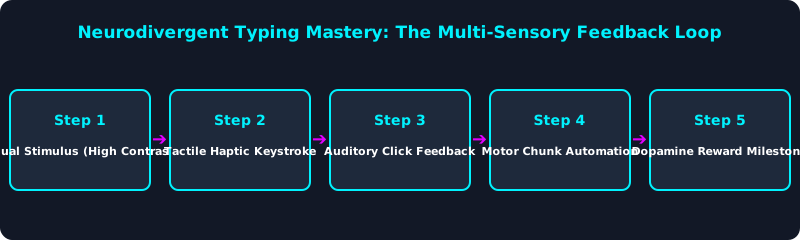
This multi-sensory diagram demonstrates how combining visual, tactile, and auditory feedback channels reinforces motor learning in neurodivergent brains.
By engaging multiple sensory pathways simultaneously, typists with ADHD and dyslexia develop robust, automated motor memory far faster than through visual drills alone.
Optimizing Hardware & Environmental Accommodations
Physical keyboard hardware plays a crucial role in maintaining focus for neurodivergent individuals. Flat, mushy membrane laptop keyboards offer virtually zero tactile feedback, making it difficult for typists with proprioceptive differences to confirm key actuation without constantly looking down.
Switching to an external mechanical keyboard equipped with tactile switches (such as Gateron Brown or Boba U4T) provides a physical 'bump' right at the actuation point. This tactile confirmation gives the nervous system immediate feedback, significantly reducing accidental double-taps.
In school and workplace settings, requesting digital accommodations (such as permission to use a laptop for examinations or utilizing speech-to-text hybrid editing) is protected under the Americans with Disabilities Act (ADA) and UK Equality Act.
5-Step Neurodivergent Keyboarding Action Plan
- Equip a Tactile Keyboard: Use an external keyboard with tactile switches that deliver satisfying physical confirmation on every keypress.
- Install High-Legibility Monospace Fonts: Configure your browser and text editor with fonts featuring distinct letter shapes and weighted baselines.
- Embrace 3-Minute Micro-Sessions: Avoid exhausting 30-minute sessions; use TypeTestLab Speed Test for 3 to 5 minutes at a time to keep focus sharp.
- Leverage Gamified Typing Modules: Use our Typing Games Engine to transform practice drills into fun, rewarding arcade challenges.
- Celebrate Consistent Progress: Focus on personal accuracy milestones rather than comparing yourself to neurotypical peer averages.
Frequently Asked Questions (FAQ)
Can touch typing really help someone with severe dyslexia?
Yes. Multiple clinical studies show that touch typing establishes kinesthetic memory pathways in the brain that bypass the phonological decoding weaknesses of dyslexia, making spelling more automatic.
What is the best typing speed goal for someone with ADHD?
A comfortable goal is 45 to 55 WPM with 95% accuracy. Aiming for consistent rhythm rather than extreme sprint speed helps prevent impulsive errors.
Are clicky keyboards good for ADHD concentration?
Many ADHD typists find the auditory click of mechanical switches (like Kailh Box White or Cherry Blue) deeply satisfying and grounding. However, in shared office or classroom spaces, tactile switches provide the same feel without disturbing others.
What accommodations can dyslexic students request for typing tests?
Students with documented learning differences can request extended time (1.5x or 2.0x), high-contrast display settings, customized fonts, and reduced distractions in testing environments.
Unlock Your True Typing Potential
Explore accessible, sensory-friendly typing assessments tailored for all cognitive styles.
Try Sensory-Friendly Speed Test ⚡