
Bank Teller & Financial Data Entry Typing Tests: 10-Key & WPM Hiring Cutoffs
In commercial banking, retail credit unions, and financial services institutions across the United States, United Kingdom, and Canada (including JPMorgan Chase, Bank of America, Wells Fargo, and Barclays), bank tellers and branch operations staff handle millions of dollars in cash, checks, and wire transfers daily.
While modern banking utilizes barcode scanners and automated bill counters, tellers must constantly key account numbers, transaction amounts, routing codes, customer IDs, and deposit slips into proprietary core banking systems like FIS, Fiserv, and Jack Henry.
Pre-employment evaluations for banking positions mandate strict proficiency in both general QWERTY keyboarding and specialized 10-key numeric keypad data entry. A single misplaced zero or inverted digit can trigger significant balance discrepancies and security flags.
📌 Key Takeaways & Executive Summary
- Global Speed Benchmark: The average unconditioned typist operates at 38–41 WPM. Mastering procedural touch typing elevates sustainable output to 65–85+ WPM.
- Accuracy Precedes Velocity: Enforcing a strict 98%+ accuracy ceiling prevents compound error cascades, allowing muscle memory to solidify faster than rushing through typos.
- Neuromuscular Chunking: High-speed typing shifts mental workload from individual letter recognition to multi-letter bi-gram and tri-gram procedural motor reflexes.
- Micro-Burst Training Model: Three focused 10-minute targeted daily sessions produce higher neuromuscular retention and lower fatigue compared to marathon practice sessions.
- Immediate Practical Application: Benchmark your baseline today using our calibrated typing engine and interactive arcade challenges to track objective progress.
Banking Industry 10-Key Keystrokes Per Hour (KPH) Benchmarks
Financial institutions evaluate numeric input using Keystrokes Per Hour (KPH). Standard clerical candidates typically register between 6,000 and 7,500 KPH. For commercial banking and teller roles, hiring managers look for candidates operating at 8,500 to 11,000+ KPH with 99%+ accuracy.
On standard QWERTY text typing assessments, tellers are expected to achieve 35 to 45 Net WPM. This speed ensures tellers can rapidly enter customer change-of-address requests, wire memos, and transaction notes while maintaining warm, professional eye contact with clients.
Crucially, financial typing tests evaluate accuracy above raw speed: uncorrected numeric errors carry severe point penalties, reflecting the real-world operational cost of ledger discrepancies.
| Banking Role | Minimum QWERTY WPM | Minimum 10-Key KPH | Accuracy Cutoff | Core Financial Tasks |
|---|---|---|---|---|
| Retail Bank Teller | 35 - 40 WPM | 8,000 KPH | 98.5% | Cash Deposits, Check Processing, Memos |
| Commercial Vault Teller | 40 - 45 WPM | 10,000 KPH | 99.2% | Bulk Currency Balancing, Merchant Drops |
| Loan Processing Clerk | 45 - 50 WPM | 9,500 KPH | 99.0% | Mortgage Data Entry, Credit Applications |
| Bank Operations Specialist | 50 - 55 WPM | 11,000 KPH | 99.5% | Wire Transfers, ACH Clearing, Ledgers |
| Branch Customer Service Rep | 40 - 45 WPM | 7,500 KPH | 98.0% | Account Setup, Customer Correspondence |
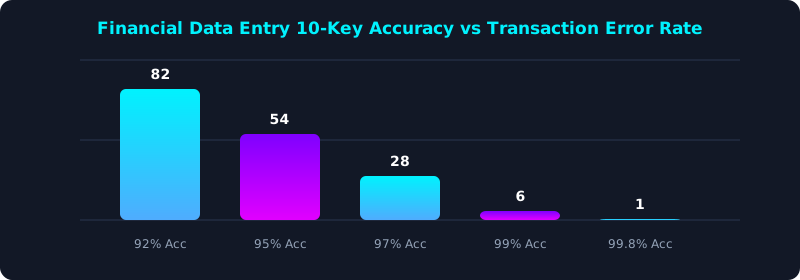
This chart illustrates the frequency of monthly balancing discrepancies in a retail bank branch based on teller 10-key numeric accuracy. Notice that dropping below 97% accuracy leads to an exponential increase in costly ledger reconciling hours.
Mastering touch technique on the 10-key numeric pad eliminates inadvertent key slips and ensures near-perfect transaction integrity.
Mastering the 10-Key Numeric Pad Touch Technique
The standard 10-key numeric pad features a physical tactile ridge on the 5 key. Your right-hand middle finger must permanently anchor on this 5 key, with the index finger covering 4, 1, 7 and the ring finger covering 6, 3, 9.
Your right thumb controls the 0 and decimal keys, while your little finger operates the Enter and addition (+) keys. Looking down at the keypad while keying currency totals creates severe neck strain and slows input speed by over 40%.
Practicing standard decimal drills (e.g., entering dollar amounts with cents: $1,425.80) builds automated muscle memory for the dot key and double-zero sequences.
5-Step Bank Teller Keyboarding Certification Blueprint
- Anchor on the 5-Key Ridge: Feel the raised nub on the 5 key with your right middle finger and keep your hand relaxed over the pad.
- Drill 10-Key Alphanumeric Data: Practice keying check numbers, decimal currency totals, and account digits using touch technique.
- Test on Timed Financial Simulations: Use TypeTestLab Speed Test to benchmark your baseline speed and verify 99%+ accuracy under pressure.
- Master Customer Multi-Tasking: Practice maintaining upright eye posture while keying numeric inputs to prepare for face-to-face branch interactions.
- Obtain a Verified Career Certificate: Earn an Official Typing Certificate validating your WPM and accuracy metrics to attach to banking resumes.
Frequently Asked Questions (FAQ)
What typing test do banks use for hiring tellers?
Banks commonly utilize Kenexa Prove It! (IBM), Criteria Basic Skills Test (CBST), or custom proprietary 10-key and data entry testing modules.
Can I use the number row instead of the 10-key pad on banking tests?
No. Pre-employment financial evaluations specifically test 10-key numeric keypad speed. Using the top number row will result in a failing KPH score.
What is considered an excellent 10-key speed for a bank teller?
An entry-level teller score of 8,500 KPH is solid. An experienced commercial teller operating above 11,000 KPH with 99% accuracy is considered top-tier.
How long does it take to learn 10-key touch typing?
Because the 10-key pad has only 17 keys, most candidates master blind touch typing within 10 to 14 days of 15-minute daily practice sessions.
Pass Your Bank Teller Typing Exam
Build fast, error-free 10-key numeric and QWERTY skills for top banking institutions.
View Banking Career WPM Standards ⚡